

When practising IELTS Speaking, I notice that many learners understand the question but still give very short responses – sometimes just a few words or a single sentence. This makes the answer feel “unfinished” and lacking depth. This doesn’t mean your English is weak; in most cases, you simply don’t know how to expand your ideas naturally.
Examiners don’t require long, complicated answers. What they want is evidence that you can develop an idea, explain it, describe it, and support it with an example. Once you understand how to expand your responses properly, IELTS Speaking becomes much more manageable.
That’s why, in this article, I’ll share 5 tips to help you expand your answers in IELTS Speaking with confidence and coherence – suitable for Part 1, Part 2, and Part 3.

5 Key Tips to Expand your IELTS Speaking Answers
Tip #1: Use the “IDEA → REASON → EXAMPLE” structure
One major reason many Speaking answers are too short is that learners mention only the main idea and then stop. While examiners don’t score you based on length, they do expect you to show that you can develop your response by stating your idea, explaining it, and giving an example.

And the IDEA → REASON → EXAMPLE structure is one of the easiest, most reliable ways to do that.
| Component | Purpose | How It Works | Example |
| IDEA | To answer the question directly and show the examiner you understand it. | – Sets the foundation for your response. – Prevents you from going off-topic or starting too broadly. – Gives you a clear starting point for further development. | I enjoy reading books. |
| REASON | To demonstrate your ability to develop your idea – something examiners actively assess. | – Acts as a bridge so your idea doesn’t feel incomplete. – Adds depth by explaining why the idea matters to you. – Creates a natural flow into the EXAMPLE step. | Because reading helps me relax after a long day. |
| EXAMPLE | To make your answer more vivid and realistic. | – Turns your explanation into a real-life image, making it more convincing. – Allows you to add another sentence without sounding like you are stretching your answer. – The safest technique to expand without going off-topic. | I usually read for about 20 minutes every night before bed. |
⭐ Sample Answer (using I → R → E)
Yes, I do – I actually enjoy cooking quite a lot (IDEA). It helps me unwind after work and gives me a sense of creativity because I can try new recipes (REASON). I often spend my Sunday afternoons experimenting with different pasta dishes at home (EXAMPLE).
Tip #2: Add Background Information
One of the simplest ways to expand your Speaking answers is to add a bit of background before giving your main point.
Background information works like a light introduction — it doesn’t make your answer unnaturally long, but it makes it sound more natural, personal, and meaningful.
Common types of background information
| Types of Background Information | How to use? | Example |
| Time | Mention a point in the past or present to set the context. | – When I was a child…, – These days…, – In the past…, |
| Age | Frame your answer within a stage of your life. | – As a teenager…, – At this stage of my life…, |
| Place | Give context related to your living environment. | – Since I live in a busy city…, – Growing up in the countryside… |
| Habit | Mention a familiar pattern or personal tendency. | – I’ve always had the habit of…, – I usually…, – I tend to… |
| Hobbies | Show your interests or personal traits. | – I’ve always been interested in…, – I’m the type of person who… |
⭐ Example
Since I grew up in a family that travelled quite often, I naturally developed a love for exploring new places (BACKGROUND). So yes, I really enjoy traveling (IDEA). It allows me to learn about different cultures and take a break from my routine (REASON).
Tip #3: Use Specific Details
Many learners answer Speaking questions in a very “generic” way – they provide the main idea but don’t describe anything specific. This makes the response lack imagery, depth, and clarity, and it becomes difficult for the examiner to judge your language ability.
Specific details help your answers sound more natural, richer in information, and longer without feeling forced – especially in IELTS Speaking Part 2.
Why Are Specific Details Important?
| Common Problem | Consequence | Benefit of Using Specific Details |
| Giving general answers with no clear picture | The examiner cannot see your vocabulary range or descriptive ability | Your answer becomes vivid, clear, and boosts Fluency & Lexical Resource |
| Stating the main idea but not expanding it | The response is too short | You naturally add 1-2 more sentences without sounding unnatural |
| Using overly simple vocabulary | The answer feels empty and lacks emotion | You get the chance to show richer descriptive vocabulary |
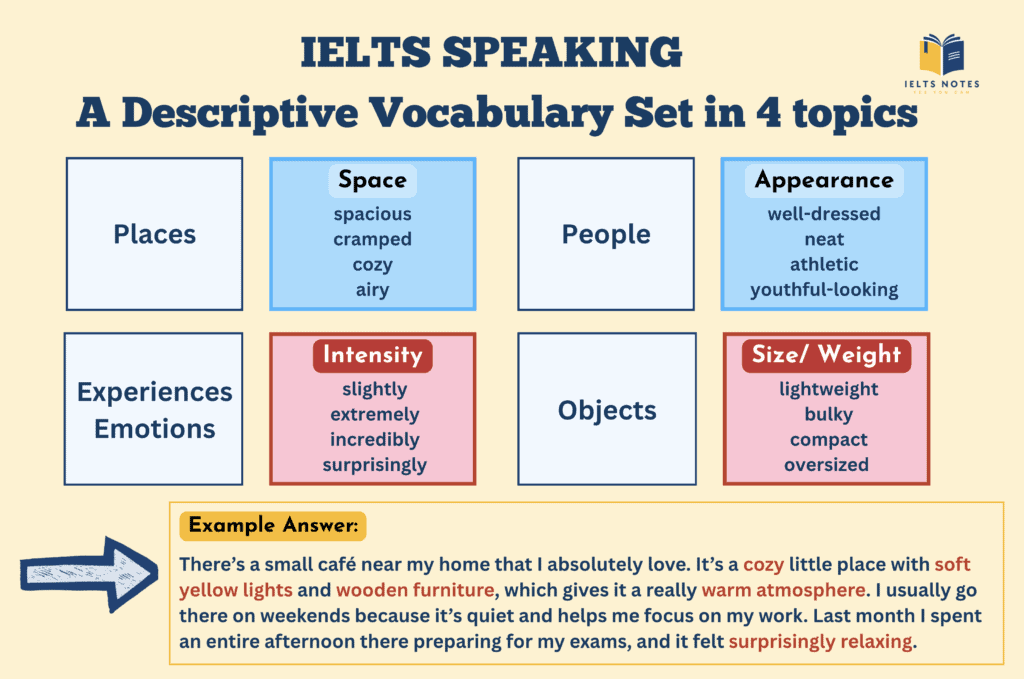
A Descriptive Vocabulary Set for 4 Common IELTS Speaking Topics
Below is a set of descriptive vocabulary grouped by common categories such as places, people, objects, and emotions. This organisation will make it easier for you to apply them in your responses.
Descriptive Vocabulary for Places
| Aspect | Suggested Vocabulary | Example Sentence |
| Space | spacious cramped cozy airy | The café is small but very cozy. |
| Atmosphere | peaceful vibrant lively quiet | It has a peaceful atmosphere, which helps me relax. |
| Design | minimalist modern industrial-style vintage | The interior has a minimalist design with wooden tables. |
| View | stunning view open view waterfront surrounded by trees | It offers a stunning view of the river. |
| Sound & Lighting | soft lighting dim lighting natural light noisy echoey | The soft lighting makes the place feel very warm. |
Descriptive Vocabulary for People
| Aspect | Suggested Vocabulary | Example Sentence |
| Personality | warm-hearted easy-going supportive introverted energetic | She’s very easy-going and fun to talk to. |
| Appearance | well-dressed neat athletic youthful-looking | He looks very athletic because he plays basketball every day. |
| Communication Style | cheerful talkative thoughtful shy confident | My teacher is cheerful and always makes the lessons enjoyable. |
| Habits | hard-working organized punctual | She’s extremely organized, which inspires me to stay on track. |
Descriptive Vocabulary for Experiences & Emotions
| Aspect | Suggested Vocabulary | Example Sentence |
| Positive emotions | refreshing inspiring relaxing motivating | The trip was refreshing and helped me clear my mind. |
| Negative emotions | overwhelming exhausting stressful | The crowded streets were quite overwhelming. |
| Intensity | slightly extremely incredibly surprisingly | The food was surprisingly good for such a small restaurant. |
| Long-term impact | memorable life-changing impactful | It was a memorable experience I’ll never forget. |
Descriptive Vocabulary for Objects
| Aspect | Suggested Vocabulary | Example Sentence |
| Size/ Weight | lightweight bulky compact oversized | The bag is lightweight, so I carry it everywhere. |
| Material | wooden metallic leather fabric ceramic | It’s made of leather and feels very durable. |
| Design/ Style | stylish minimalist vintage-style elegant | The design is minimalist but very stylish. |
| Function | practical convenient multi-functional | It’s a very practical device for students. |
⭐ Example
There’s a small café near my home that I absolutely love. It’s a cozy little place with soft yellow lights and wooden furniture, which gives it a really warm atmosphere (SPECIFIC DETAILS). I usually go there on weekends because it’s quiet and helps me focus on my work (REASON). Last month I spent an entire afternoon there preparing for my exams, and it felt surprisingly relaxing (EXAMPLE).
→ As you can see, just adding a few small details about the lighting, atmosphere, or emotions can make your answer much more vivid and engaging.
Tip #4: Use Comparisons to Add Depth to Your Answers
Comparison is one of the most natural ways to expand your answer in IELTS Speaking, especially in Part 3.
When you compare ideas, your response becomes longer and demonstrates your ability to analyse – something examiners highly value in both Fluency & Coherence and Lexical Resource.
Why do comparisons make your answers deeper?
| Benefit | Explanation |
| Adds depth | When you compare, you’re not just describing one thing – you’re placing it in relation to something else, which creates richer content. |
| Shows linguistic flexibility | You naturally use a wider range of structures and vocabulary to express contrasts and similarities. |
| Sounds natural in conversation | Native speakers frequently compare things when speaking, so your answer feels more authentic. |
| Perfect for Part 3 | Part 3 requires broader thinking, evaluation, and analysis – comparison makes your arguments more convincing. |
Common types of comparisons
| Comparing past ↔ present | Compared to the past… These days…, but in the past… …has become much more common than it used to be. |
| Comparing yourself ↔ other people | Unlike many people my age… I’m quite different from my friends in that… My parents tend to…, while I… |
| Comparing two options | On the one hand…, on the other hand… A is generally more… than B. While A offers…, B provides… |
⭐ Example
Question: Do you think people read more now than in the past?
Compared to the past, I think people actually read less these days. In the past, reading was one of the main sources of entertainment, while now people have access to social media and streaming platforms, which are much more convenient. Personally, I still enjoy reading, but most people around me tend to spend more time on their phones than on books.
Read more
Tip #5: Add Personal Feelings & Opinions
One of the simplest ways to make your Speaking answers sound more natural is to include a bit of personal feeling.
Sharing your feelings or personal evaluation gives your answer personality and shows that you can use language flexibly – something examiners look for in Fluency & Coherence and Lexical Resource.
Common expressions types of feelings and opinions
| Type of feeling/opinion | Useful expressions |
| Likes/ Enjoyment | – I enjoy… – I love… – I’m really into… – I appreciate… |
| Dislikes/ Hesitation | – I’m not a big fan of… – I find it a bit tiring… – It doesn’t really appeal to me… |
| Neutral/ Depends on context | – It depends… – I don’t mind… – I’m okay with it… |
| Personal feelings | – I feel that… – I find that… – For me… – Personally speaking… |
| Opinions/ Judgments | – It seems to me that… – I believe… – In my opinion… – From my perspective… |
⭐ Example
Question: Why do some people prefer working from home?
Personally, I think many people enjoy working from home because it gives them a greater sense of comfort and control. I find that staying in a familiar environment helps me concentrate better and feel less stressed. What I appreciate most is the flexibility – it allows me to manage my time more effectively without the pressure of commuting every day.
Read more
Conclusion
In the end, expanding your answers in IELTS Speaking isn’t about talking as much as possible – it’s about speaking with purpose: adding the right details, developing your ideas, and sounding natural.
Once you learn how to add background context, specific details, examples, comparisons, and personal feelings, your responses will instantly become clearer, richer, and more fluent without feeling forced.
If you’re just starting out, you don’t need to practise everything at once. It’s often more effective to focus on one technique per week – for example, use IDEA → REASON → EXAMPLE this week, then try adding Background Information next week. This slow-but-steady approach helps you build real speaking reflexes over time.
I hope these tips make your Speaking practice feel lighter, more manageable, and a lot less stressful.If this official scoring guide helped make the process clearer, feel free to follow IELTS Notes on Facebook, Tiktok, Youtube, and Pinterest. We’ll continue sharing practical explanations and useful resources to support you on your journey toward your target band.