

IELTS Writing is a skill that requires a well-planned approach. You do not need to write as many essays as possible.
Instead, you need to know what to focus on at each stage, from building the foundation and practising specific skills to improving your writing based on the official IELTS band descriptors.
In this article, I will introduce a 30-day strategy to improve your IELTS Writing score. The plan is divided into clear stages to help you study with the right focus, improve step by step, and raise your band score in a realistic and sustainable way.
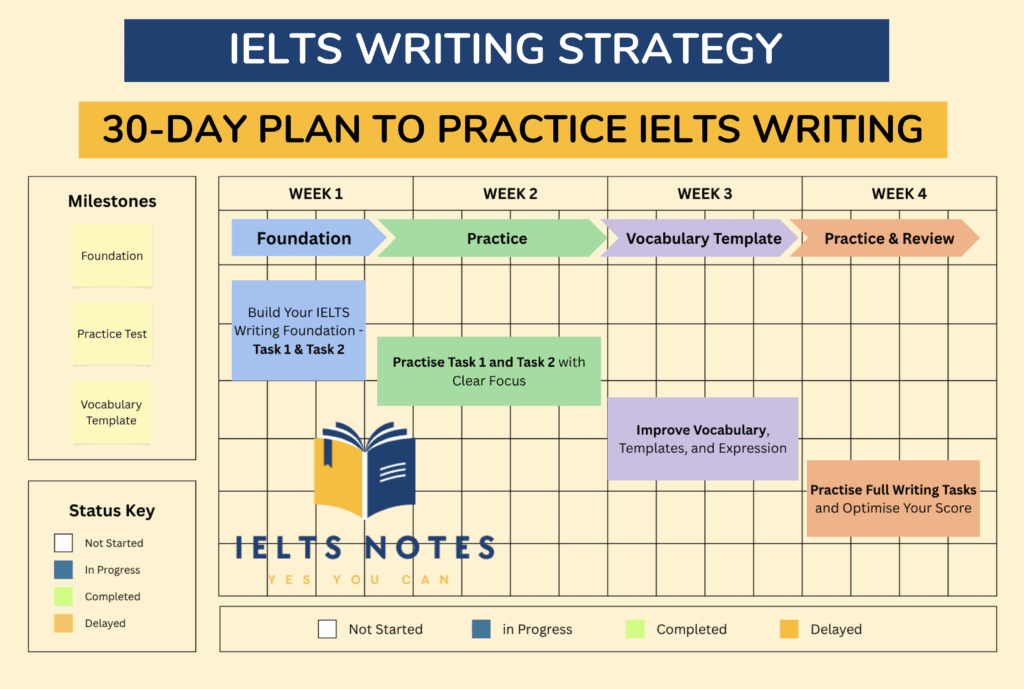
Overview of the 30-Day IELTS Writing Study Plan
Before going into the daily practice schedule, it is important to look at the bigger picture of the whole plan. This helps you understand where you are starting from, which stages you will go through, and what the goal of each stage is.
A good study plan is not just a list of writing exercises. It should have a logical order and clear objectives, helping you improve smaller writing skills before bringing everything together to improve your overall band score.
The Core Logic Behind This IELTS Writing Plan
Instead of doing full practice tests from the beginning or writing essay after essay without direction, you should follow four main steps:
- Build the foundation: Understand the test format, assessment criteria, and basic essay/report structure.
- Practise specific skills: Write in a controlled way and focus on one task at a time.
- Upgrade your language: Improve your vocabulary, sentence structures, and coherence.
- Optimise and practise under exam conditions: Apply everything you have learned to complete IELTS Writing tasks within the real time limit.
This approach helps you avoid the common problem of “writing a lot but not improving”. More importantly, it ensures that each week has a clear purpose and direction.
Read more
The 4 Stages of the 30-Day IELTS Writing Plan
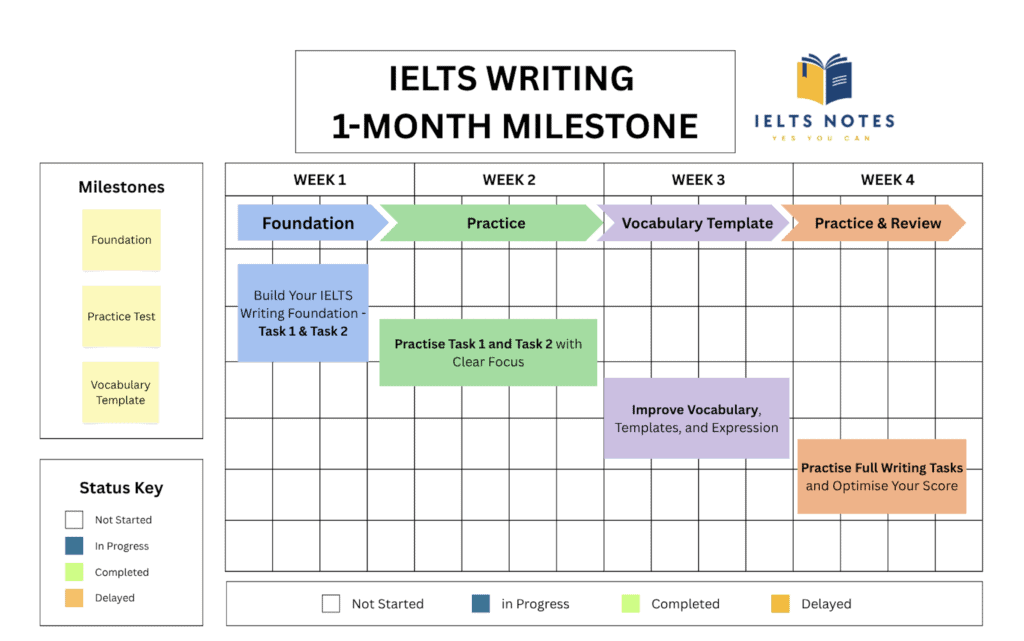
| Stage 1 | Build Your IELTS Writing Foundation – Task 1 & Task 2 |
| Stage 2 | Practise Task 1 and Task 2 with Clear Focus |
| Stage 3 | Improve Vocabulary, Templates, and Expression |
| Stage 4 | Practise Full Writing Tasks and Optimise Your Score |
IELTS Notes’ Tips: How to Build an Effective Study Plan
This way of planning does not only apply to IELTS Writing. You can also use the same approach to build a study plan for other IELTS skills, such as Speaking or Reading.
An effective study plan usually includes four steps:
- Step 1: Identify your specific weaknesses, such as lacking ideas, writing off-topic, having poor structure, or making basic grammar mistakes.
- Step 2: Break down the skills you need to improve, such as structure, idea development, vocabulary, grammar, coherence, and task response.
- Step 3: Practise one skill group at a time instead of trying to improve everything at once.
- Step 4: Always review your work and make improvements after each practice task.
The biggest difference between learners who improve quickly and those who stay stuck is not how many hours they study. It is whether they have a clear practice system and know how to correct their mistakes after each piece of writing.
A Specific 30-Day Strategy to Improve Your IELTS Writing Score
After understanding the overall structure of the plan, the next step is to look at the specific 30-day IELTS Writing practice schedule.
Instead of studying randomly or doing practice tests without direction, you will know exactly what to do each day, which skill to improve, and why that practice matters.
In the sections below, I will walk you through each stage of the 30-day IELTS Writing plan, with practical guidance that you can apply to your daily practice.
Stage 1 (Week 1): Build Your IELTS Writing Foundation – Task 1 + Task 2
The goal of this week is not to write perfect essays. Instead, it is to understand how IELTS Writing works.
You need to become familiar with the structure of Task 1 and Task 2, the common question types, and the IELTS Writing assessment criteria so that you know what a good answer should include.
Day 1 & Day 2: Assess Your Current Level and Create a Study Plan
Before you begin your Writing practice, you need to understand your current level and your target score. Without this step, your learning process can easily become unfocused, making it harder to see clear progress.
Test Your Ability
If you’re a complete beginner and you want to test your IELTS Writing level at home, here’s a simple way to do it.
- First, try a real IELTS format.
- Write Task 1 in 20 minutes and Task 2 in 40 minutes. Don’t use Google or any tools—just write what you can.
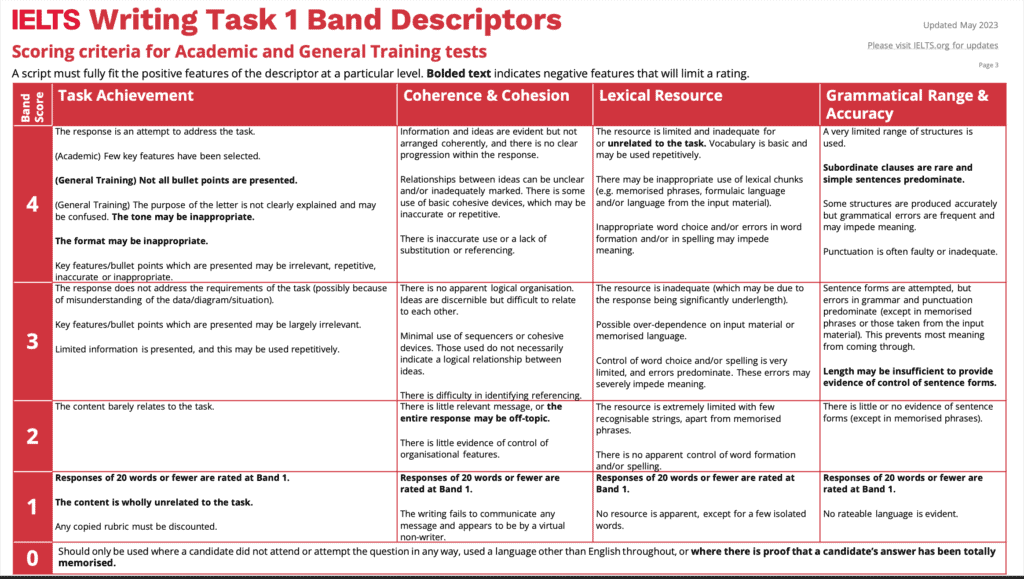
- After you finish, copy your writing into AI and ask it to give you a band score based on the 4 criteria:
- Task Achievement (Task 1) / Task Response (Task 2): Have you answered the question fully and appropriately?
- Coherence and Cohesion: Is your writing logical, easy to follow, and well connected?
- Lexical Resource: Is your vocabulary varied, accurate, and suitable for the topic?
- Grammatical Range and Accuracy: Do you use a range of sentence structures with good grammatical control?
Set Your Target and Build Your Study Plan
After identifying your current level, the next step is to set a target band score and build your 30-day IELTS Writing study plan.
Here is a suggested process:
- Step 1: Identify your target band score.
- Step 2: Analyse the weaknesses from your completed Writing test.
- Step 3: Allocate your study time to different Writing skills.
- Step 4: Build a weekly study plan.
IELTS Notes’ Key Note: Create Your Study Plan From the Beginning
A common mistake among IELTS learners is starting to study immediately without a clear study plan. This often leads to an unstructured learning process and makes it difficult to track progress.
To avoid this, you should spend time creating a specific study plan from the very beginning. You can also read IELTS Notes’ article “How to Create an Effective 6-Month IELTS Study Plan” to better understand how to allocate your study time and build a long-term IELTS preparation roadmap.
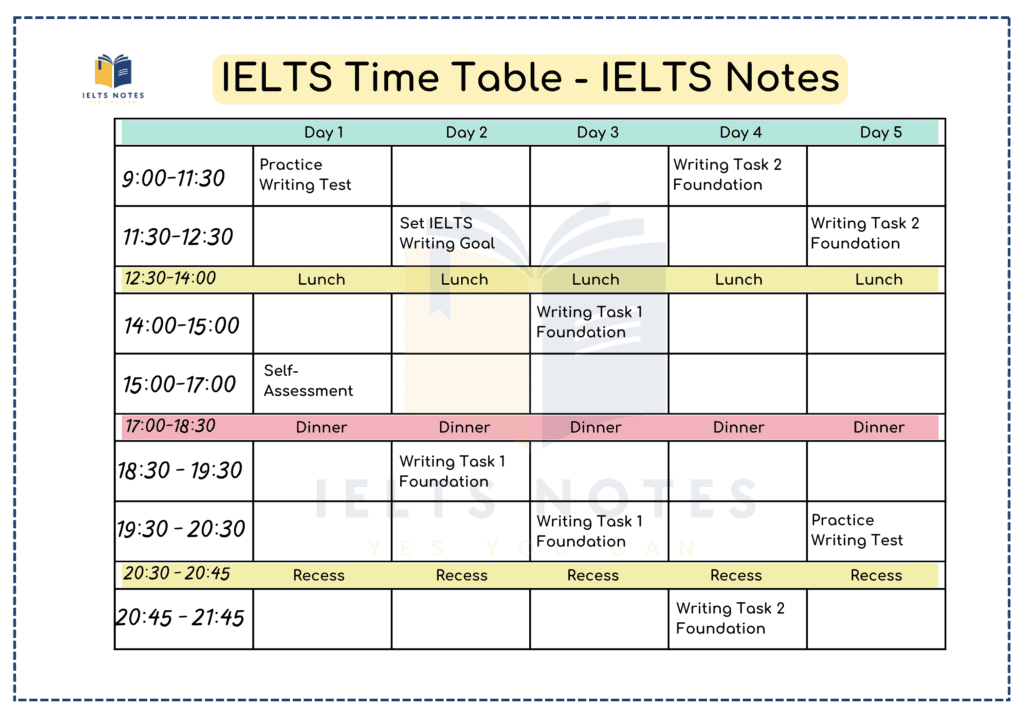
You can download IELTS Notes’ effective study plan timetable template below.
Day 3 & Day 4: Get Familiar with IELTS Writing Task 1
After assessing your current level and creating a clear study plan, the next step is to build a strong foundation for IELTS Writing Task 1. This is a section that many learners approach without a clear method, which often leads to unfocused writing or missing key information.
During these two days, your goal is not to write a perfect Task 1 answer. Instead, you should focus on understanding the main question types and the standard structure of a Task 1 response. Once you understand the framework, your later practice will become much easier and more effective.
Understand the Main Types of IELTS Writing Task 1
Common IELTS Writing Task 1 question types include:
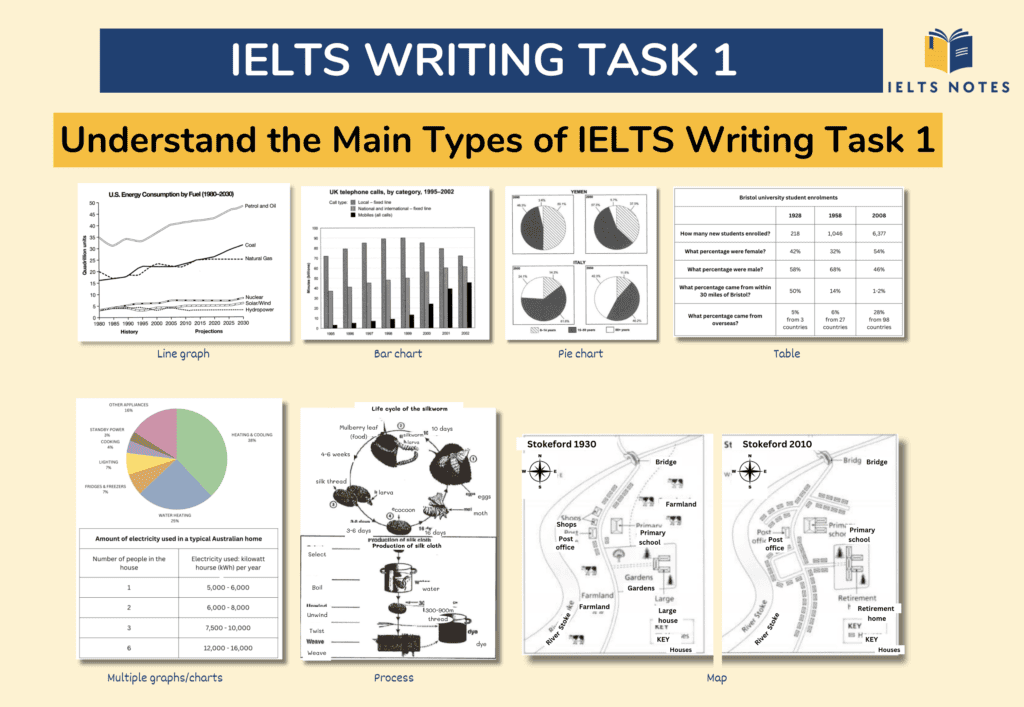
| Data-based Tasks | – Line chart – Bar chart – Pie chart – Table – Mixed charts |
| Process Diagrams | – Manufacturing process – Natural process |
| Map | – Comparing maps over time – Future development plans |
If you are not familiar with all Task 1 question types yet, you do not need to memorise everything immediately. At this stage, your goal is simply to recognise each type and understand the basic approach for dealing with it.
To do this, you can refer to IELTS Notes’ article “IELTS Writing Task 1 Tips and Tricks: The Ultimate Guide”. This guide not only introduces the main Task 1 question types, but also helps you understand:
- What to focus on in each question type
- How to select important data instead of describing everything
- Common mistakes that may lower your score even when your information is not wrong
After reading it, you will have a clearer overview of Task 1 and find it easier to apply the right approach in your practice.
Understand the Basic Structure of an IELTS Writing Task 1 Answer
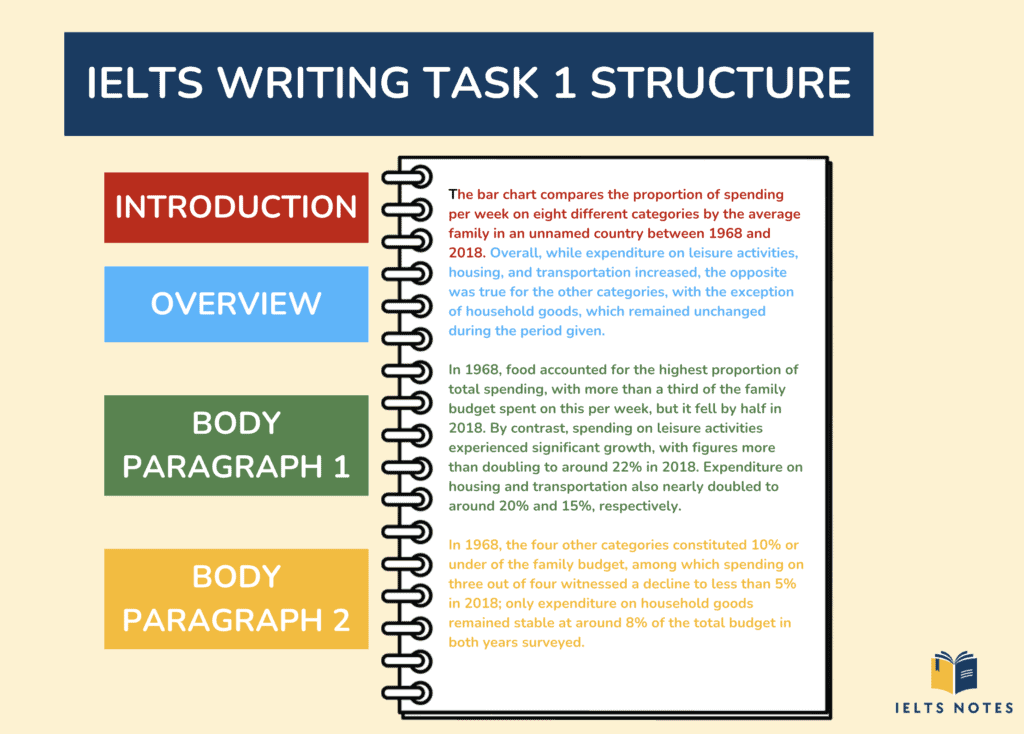
A standard IELTS Writing Task 1 answer usually includes three main parts:
| Introduction | – Paraphrase the question – Do not add personal opinions |
| Overview | – Summarise the most important features – Do not include detailed numbers |
| Body Paragraphs | – Describe trends, changes, or comparisons in detail – Group information logically |
IELTS Writing Task 1 Structure
Day 5, Day 6 & Day 7: Get Familiar with IELTS Writing Task 2
While Task 1 requires you to describe information accurately, Task 2 tests your ability to build arguments, develop ideas, and present your opinion clearly.
Task 2 also accounts for a larger proportion of your IELTS Writing score, so if you want to improve your overall Writing band, you need to spend more time on this part.
Understand the Main Types of IELTS Writing Task 2
IELTS Writing Task 2 includes several essay types. The most common ones are:
| – Opinion Essay (Agree/Disagree) – Discussion Essay (Discuss both views) – Advantages/Disadvantages Essay – Two-part Question (Direct Questions) – Causes/Effects Essay – Problems/Solutions Essay |
If you are not familiar with how to handle a specific essay type, you can start with this article “IELTS Writing Task 2: Advantages and Disadvantages”.
Once you understand how to approach one essay type properly, it will be much easier to apply the same thinking process to other Task 2 question types.
Understand the Basic Structure of an IELTS Writing Task 2 Essay
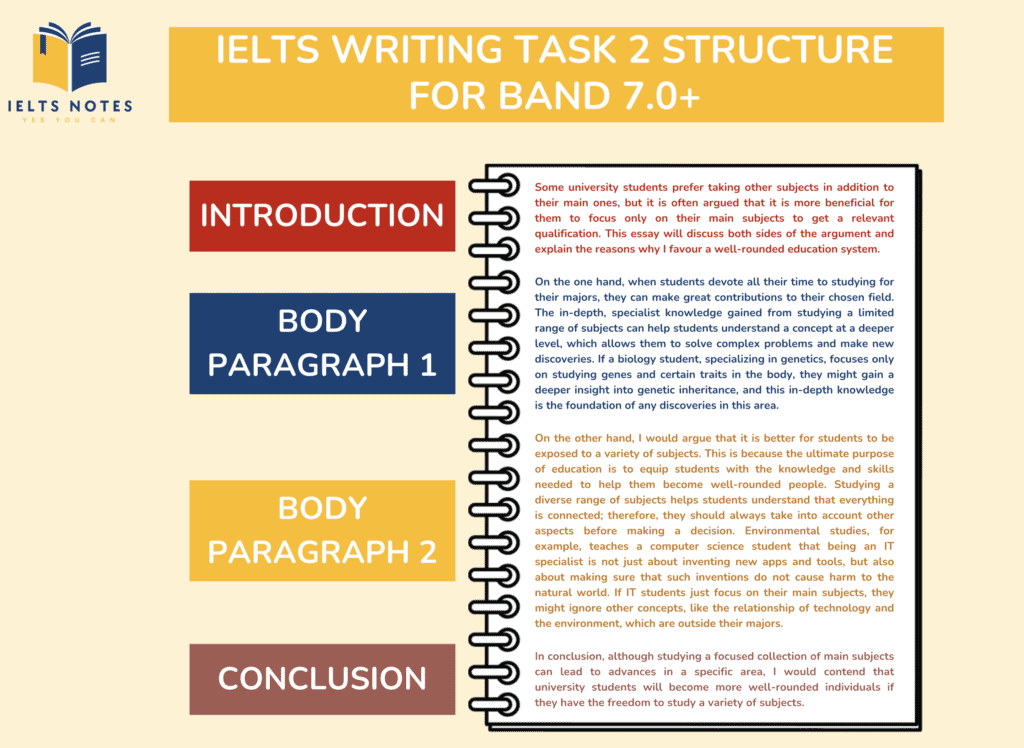
A basic IELTS Writing Task 2 essay usually includes four parts:
- Introduction: Paraphrase the question and present your position
- Body Paragraph 1: Main idea 1, explanation, and example
- Body Paragraph 2: Main idea 2, explanation, and example
- Conclusion: Summarise the main points and restate your position
If you are not sure how to develop each part, you can read “IELTS Writing Task 2 Structure: The Complete Guide for Band 7+”.
The purpose of this article is not to give you a fixed formula. Instead, it helps you:
- Understand the role of each part of the essay
- Organise your ideas more clearly
- Avoid writing in an unfocused or disconnected way
When your essay structure is clear, your writing becomes easier to follow and directly improves your Coherence and Cohesion score.
Besides structure, another common problem is running out of ideas or failing to develop ideas deeply enough. This often happens when learners do not have a clear content framework to rely on.
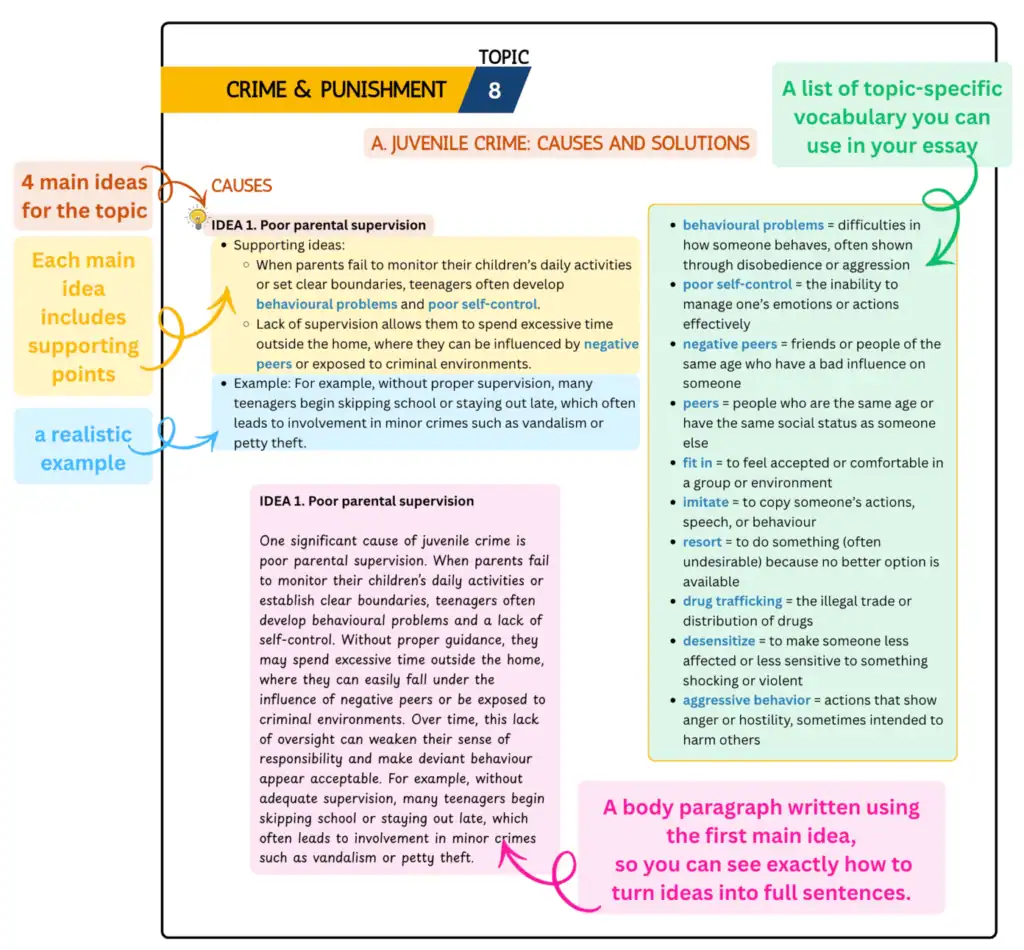
If you struggle with this, you can refer to “Ideas and Vocabulary for IELTS Writing Task 2”. This article helps you:
- Build ideas for common IELTS topics
- Expand your points instead of writing in a general way
- Use suitable vocabulary to express your ideas more clearly
Once you have a stronger foundation in ideas and vocabulary, writing Task 2 essays will become much faster, clearer, and more logical.
Read more
Stage 2 (Week 2): Learn to Write Each Section Clearly
In Week 2, we’re not writing full essays yet. Instead, we focus on practicing each question type
You’ll break the task into smaller parts and practice each section separately.
For example:
- Instead of writing a full Task 2 essay, you just practice writing the introduction first.
- Then maybe the next day, you focus only on writing body paragraphs—how to develop ideas, how to give examples.
- After that, you can practice writing conclusions.
At this stage, focus on two foundation skills: generating ideas and building a clear structure.
Choose 2–3 Task 2 questions and practise the following process:
- Read the question carefully
- Identify the essay type
- Create a complete outline, including the introduction, main ideas for the body paragraphs, and the direction of the conclusion.
This helps you train your argument-building skills without being under too much pressure from timing or wording.
One common reason many students get stuck in Task 2 is a lack of ideas. When you do not have a clear direction, your writing can easily become too general or repetitive.
To improve this, you can use “Ideas and Vocabulary for IELTS Writing Task 2”, a resource compiled by IELTS Notes. It organises ideas by common IELTS topics such as education, environment, and technology, while also providing useful vocabulary that you can apply directly to your essays.
Stage 4 (Week 4): Practise Task 1 and Task 2 Under Exam Conditions
At this stage, you’re no longer practicing small parts. You’re writing full Task 1 and Task 2 under real exam conditions.
That means you give yourself 60 minutes in total: 20 minutes for Task 1, and 40 minutes for Task 2.
After you finish, give your writing to a teacher if you have one. That’s always the best option. But if you don’t, just copy it into AI and ask for a band score and feedback.
Day 1 – 3: Practise Task 1 – Charts and Graphs Under Exam Conditions
Task 1 Practice: Charts and Graphs
On the first day, you should write one complete Task 1 answer in 20 minutes. Prioritise common chart types such as line graphs, bar charts, and pie charts. These question types appear frequently and are also useful for practising how to describe trends and make comparisons.
When practising, focus on two key elements:
- Write a clear overview: Identify 2 – 3 main trends or key features instead of describing every detail.
- Select key information carefully: Do not try to include every number. Group the data logically so that your answer is easy to follow.
Task 1 Practice: Accuracy and Vocabulary
On the second day, instead of writing a new answer immediately, go back to your previous Task 1 response and complete the most important step that many students often skip: review and rewrite.
A simple review and rewriting process for IELTS Writing Task 1:
- Step 1: Read your answer again and identify the mistakes. Are there basic grammar errors, such as verb tense or singular/plural mistakes? Are some words used inaccurately? Are any sentences unclear or repetitive?
- Step 2: Compare your answer with Band 7 – 8 samples to see the differences.
- Step 3: Rewrite your answer with a clear goal: make your sentences clearer, your vocabulary more accurate, and your structure more coherent.
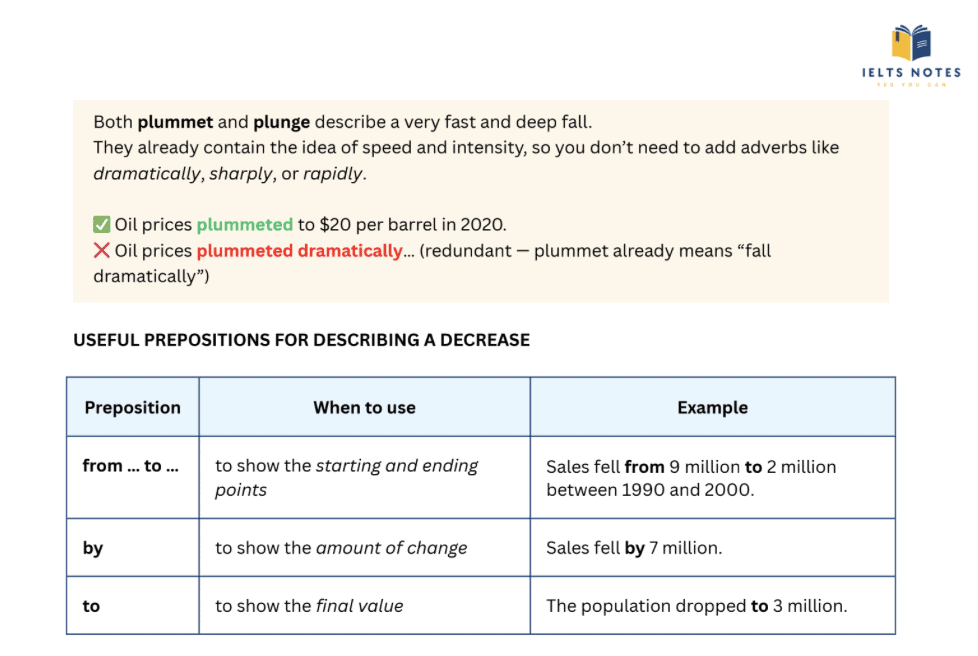
If you are not sure where to start, you can refer to IELTS Notes’ article “IELTS Writing Task 1 Trend Vocabulary: Essential Vocabulary for Graphs and Charts”. This article helps you organise vocabulary into clear groups, such as words for increases, decreases, fluctuations, and stability. It also shows you how to use these words in context instead of memorising them separately.
You can read the full guide and download the free PDF to practise and apply the vocabulary to your own writing.
Task 1 Timed Practice
On the third day, you will increase the intensity of your practice by writing two Task 1 answers under timed conditions. Spend 20 minutes on each answer.
This step helps you get used to time pressure and check whether you can maintain your writing quality when working faster.
Day 4 – 7: Practise Task 2 – Ideas, Structure, and Writing Under Exam Conditions
If the first three days help you get used to Task 1 under time pressure, the next four days will focus on Task 2, the part that has a major impact on your overall Writing band score.
At this stage, you are not only practising essay writing. More importantly, you are learning how to generate ideas, build arguments, and improve your essay after each practice attempt.
Task 2 Full Essay Practice
Make sure your essay has:
- A clear structure
- A direct response to the question
- Arguments that are clear and easy to follow
After finishing your essay, do not move immediately to a new question. Spend time reading your answer again and completing the most important step: review and rewrite.
When reviewing your essay, ask yourself:
- Have I answered the question directly?
- Are my ideas clear and explained properly?
- Do I repeat any grammar or vocabulary mistakes?
Then rewrite your essay with the goal of improving one point at a time. This process is what helps you raise your band score, not writing many essays without reflection.
Read more
Task 2 Timed Practice
On the final day of this stage, increase the intensity by writing two complete Task 2 essays under timed conditions. Spend 40 minutes on each essay.
The goal is to check whether you can:
- Maintain a clear structure
- Develop your ideas deeply enough
- Keep your writing quality stable under time pressure
Read more
Conclusion
A 30-day strategy to improve your IELTS Writing score is not about studying as much as possible. It is about learning in the right order and practising with a clear system.
When you understand your weaknesses, practise with the right focus, and review your work after each writing task, improvement becomes clearer and more manageable.
If you want to keep learning with more IELTS materials, study plans, and detailed guides for each IELTS skill, you can follow IELTS Notes across Facebook, Tiktok, Youtube, and Pinterest so you do not miss the latest and most useful resources for your IELTS preparation.