

If you’ve ever faced a map labeling task in the IELTS Listening test, you know how stressful it can be.
In today’s lesson, I’ll share some useful vocabulary and tips that will help you follow directions more easily and find the correct answers.
Common Directional Words
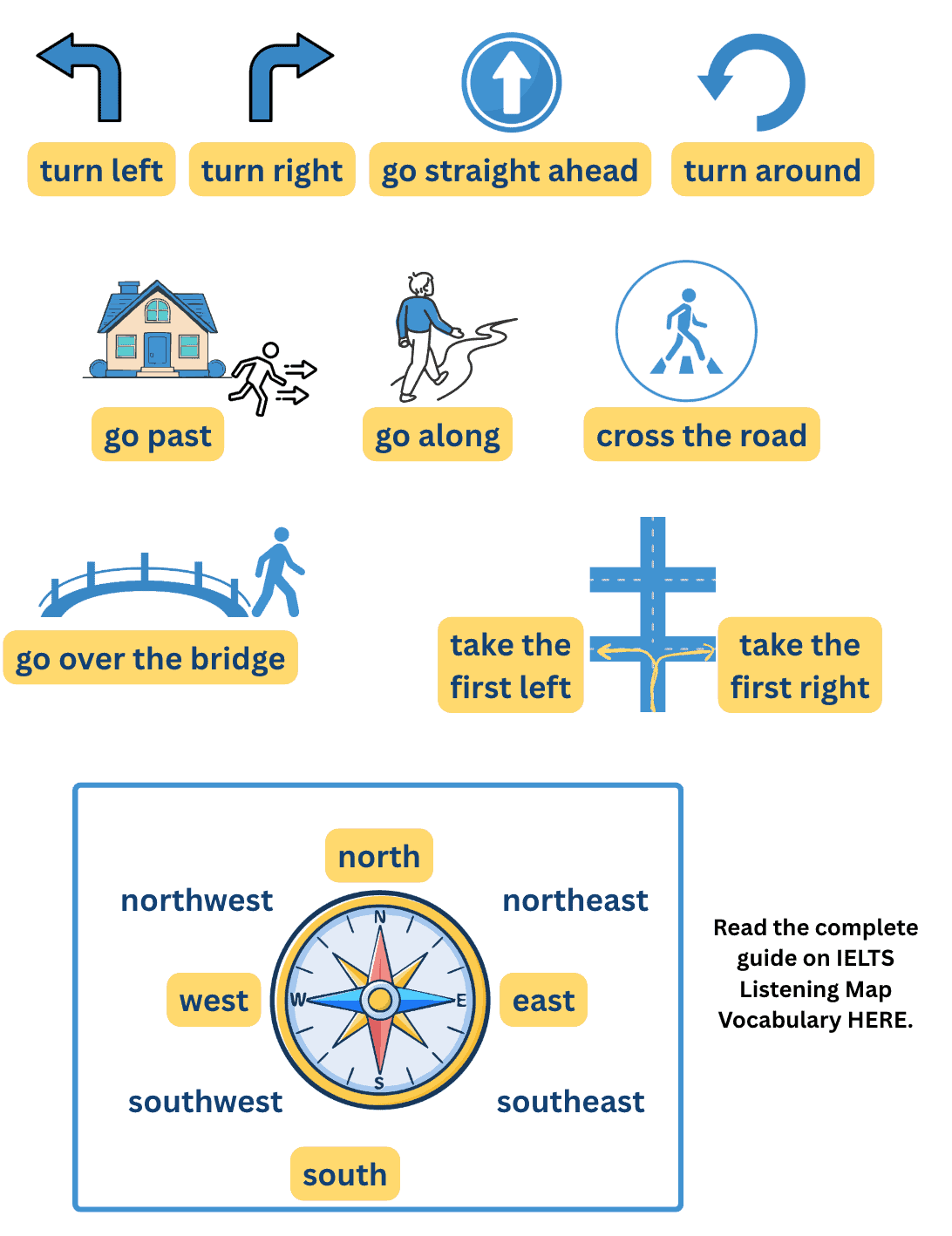
When giving directions, speakers use verbs like go, turn, cross, and follow to describe how to move around the map.
You might hear phrases such as:
“Go straight ahead until you reach the bridge.”
“Turn right at the traffic lights.”
“Go past the library.”
“Cross the road and keep going.”
“Take the second left and you’ll see the café.”
Other useful verbs include head towards, walk along, continue, or keep going — all describing movement in a certain direction.
For example, “Head towards the river,” or “Keep going along the main road until you see the park.”
💡 Tip: The speaker often uses two or more verbs together:
“Go past the post office and turn left at the corner.”
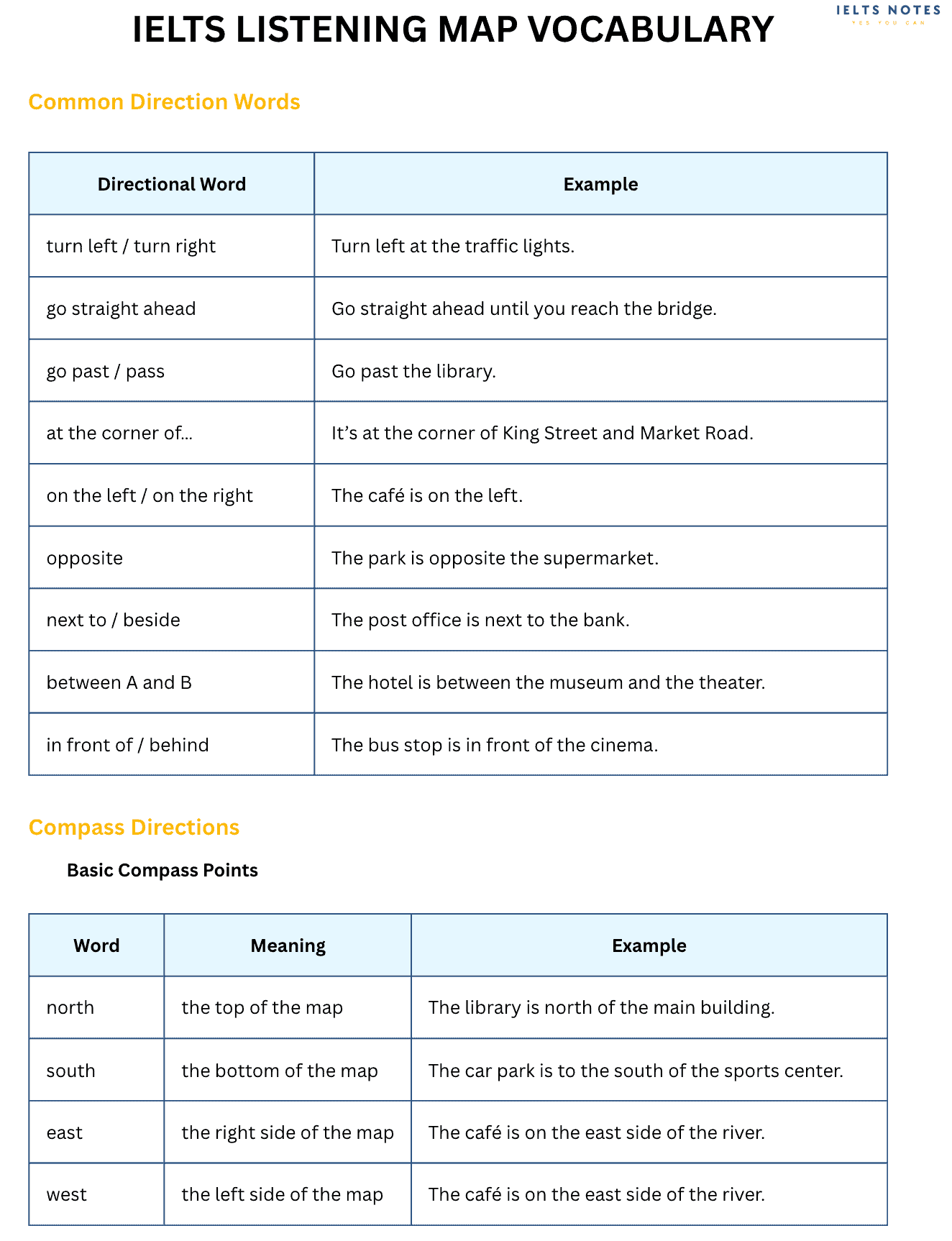
| Directional Word | Example |
|---|---|
| turn left / turn right | Turn left at the traffic lights. |
| go straight ahead | Go straight ahead until you reach the bridge. |
| go past / pass | Go past the library. |
| at the corner of… | It’s at the corner of King Street and Market Road. |
| on the left / on the right | The café is on the left. |
| opposite | The park is opposite the supermarket. |
| next to / beside | The post office is next to the bank. |
| between A and B | The hotel is between the museum and the theater. |
| in front of / behind | The bus stop is in front of the cinema. |
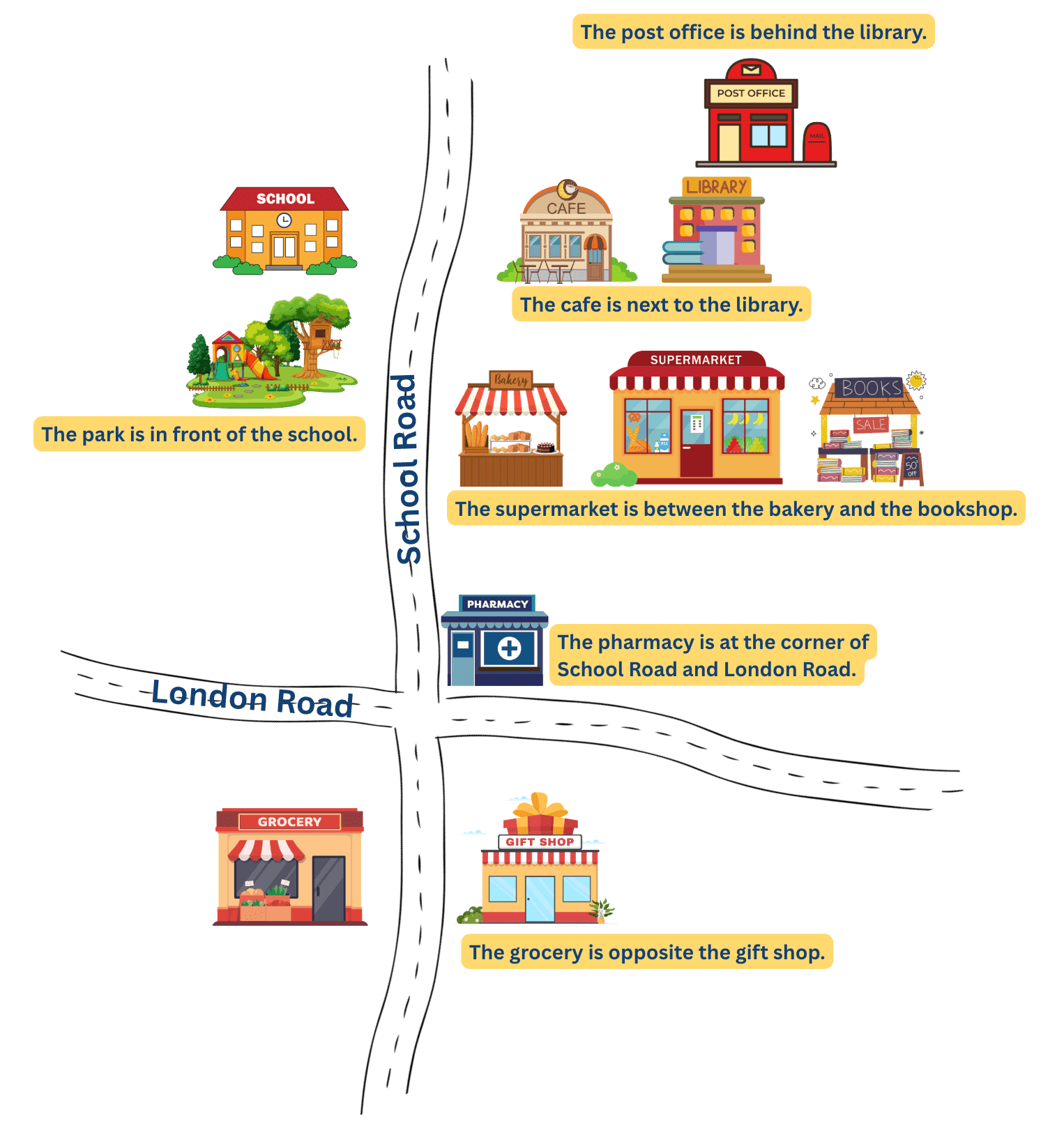
To describe where something is, you’ll need prepositions and phrases of position.
These help you understand relationships between places on the map.
For example:
“The café is next to the supermarket.”
“The park is opposite the museum.”
“The bus stop is behind the library.”
“The main entrance is in front of the reception.”
“The gym is between the car park and the swimming pool.”
You might also hear phrases like “on the left,” “on the right,” “around the corner,” or “near the station.”
These are extremely common in IELTS Listening Part 2 when describing campus or city maps.
Compass Directions
Basic Compass Points
| Word | Meaning | Example |
|---|---|---|
| north | the top of the map | The library is north of the main building. |
| south | the bottom of the map | The car park is to the south of the sports center. |
| east | the right side of the map | The café is on the east side of the river. |
| west | the left side of the map | The café is on the east side of the river. |
💡 Tip: In most IELTS maps, north is shown at the top — but always check the compass icon on the map before you start.
Combined Directions
| Word | Meaning | Example Sentence |
|---|---|---|
| northeast (NE) | between north and east | The student dormitories are in the northeast corner of the campus. |
| northwest (NW) | between north and west | The bus station is in the northwest corner of the map. |
| southeast (SE) | between south and east | The café is in the southeast corner, near the main road. |
| southwest (SW) | between south and west | The playground is in the southwest part of the park. |
Useful Phrases You Might Hear
- “In the north of the city”
- “To the south of the river”
- “In the northeast corner of the map”
- “On the western side of the building”
- “Just east of the roundabout”
These expressions are extremely common, especially when describing campus maps, towns, or tourist areas.
Common Landmarks and Places
Using Landmarks as Clues. Speakers often use landmarks to guide you. These might be buildings like a library, bank, or café, outdoor features like a river, park, or bridge, or facilities such as a bus stop, car park, or sports center.
For example:
“Walk past the café, cross the bridge, and the sports center is on your left.”
“Go along the path beside the lake until you reach the main entrance.”
Landmarks act as visual checkpoints — once you hear them, look for their location on the map and trace the path.
Buildings
| Building | Example |
|---|---|
| library | The library is next to the main entrance. |
| post office | Go past the post office and turn left. |
| museum | The museum is opposite the bus stop. |
| theater | The theater is just behind the café. |
| supermarket | There’s a supermarket on the west side of the road. |
| bank | The bank is on the corner of King Street. |
| bookshop | You’ll find the bookshop between the café and the library. |
| restaurant / café | The café is on your right, beside the bridge. |
Outdoor Areas and Natural Features
| Place | Example |
|---|---|
| park / garden | The park is in the center of the map. |
| river / lake | The café is beside the river. |
| bridge | Cross the bridge and the museum will be on your left. |
| hill | The viewpoint is on the top of the hill. |
| forest / woods | The campsite is just south of the forest. |
| beach | The hotel is located right next to the beach. |
Roads, Paths, and Public Areas
| Word | Example |
|---|---|
| road / street / avenue | Go along Green Street until you reach the roundabout. |
| roundabout | Turn right at the roundabout. |
| footpath / pathway | Follow the footpath beside the lake. |
| crossroads / junction | The café is at the crossroads. |
| square / plaza | The statue is in the middle of the town square. |
Common Direction Phrases You’ll Hear
In IELTS Listening, the speaker won’t always use single words. They often use full phrases like:
- “Go past the library.”
- “It’s on your left-hand side.”
- “Walk towards the river.”
- “It’s opposite the post office.”
- “Take the first right, then turn left.”
- “It’s just around the corner.”
- “Go back the way you came.”
- “You’ll see it straight ahead.”
- “It’s at the end of the road.”
Free PDF IELTS Listening Map Vocabulary
I’ve made a PDF file for you to practice with — you can download it and follow along while you study.
This website is so helpful for me in preparing for IELTS exam
Thank you so much! I’m really glad to hear that it’s been helpful for your IELTS preparation 😊
Wishing you all the best with your exam — you’ve got this!