

When you write about a line graph, bar chart, or table in IELTS Writing Task 1, it’s not enough to just describe the numbers.
Examiners want to see that you can use accurate and varied vocabulary to describe trends — how something changes over time.
So instead of repeating “increase” or “decrease,” let’s look at different ways to describe trends clearly and naturally.
How to describe an increase
Use these verbs when the line on your chart goes up.
| Common verbs | Common adverbs |
|---|---|
| increase rise climb grow go up surge (for sudden, strong growth) rocket (for extremely fast, dramatic growth — like a rocket shooting up) | dramatically sharply significantly gradually steadily slightly |
Both surge and rocket already mean “increase very quickly and suddenly.”
That’s why you don’t usually need an adverb like dramatically or sharply — the meaning is already built in.
✅ Sales surged to 9 million in 2000.
❌ Sales surged dramatically to 9 million. (“surged” already implies dramatic change)
Useful Prepositions for describing an increase
| Preposition | When to Use | Example |
|---|---|---|
| from … to … | to show the starting and ending points | Sales increased from 2 million to 9 million between 1990 and 2000. |
| by | to show the amount of change | Profits rose by 30% in one year. |
| to | to show the final value | The number of users grew to 5 million in 2020. |
💡 Tip:
➡ Use “from … to …” when describing the start and end points.
➡ Use “by …” when describing the amount of change.
Let’s look at this sentence:
Sales increased from 2 million to 9 million.
Here, we know:
👉 The starting point = 2 million
👉 The ending point = 9 million
So if we do the math:
🧮 9 − 2 = 7
That “7 million” is the amount of change, and that’s exactly when we use “by.”
✅ Sales increased by 7 million.
→ means the difference between the two numbers is 7 million.
✅ Sales increased from 2 million to 9 million.
→ means it started at 2 million and ended at 9 million.
How to describe a decrease
Use these verbs when the line on your chart goes down.
| Common verbs | Common adverbs |
|---|---|
| decrease fall drop decline go down plunge (for a sudden, deep fall) plummet (for a very fast and steep fall) | dramatically sharply significantly gradually steadily slightly |
Both plummet and plunge describe a very fast and deep fall.
They already contain the idea of speed and intensity, so you don’t need to add adverbs like dramatically, sharply, or rapidly.
✅ Oil prices plummeted to $20 per barrel in 2020.
❌ Oil prices plummeted dramatically… (redundant — plummet already means “fall dramatically”)
Useful Prepositions for describing a decrease
| Preposition | When to Use | Example |
|---|---|---|
| from … to … | to show the starting and ending points | Sales fell from 9 million to 2 million between 1990 and 2000. |
| by | to show the amount of change | Sales fell by 7 million. |
| to | to show the final value | The population dropped to 3 million. |
How to describe fluctuations
Use these words when numbers go up and down repeatedly.
| Common verbs | Nouns |
|---|---|
| fluctuate vary | fluctuation variation |
Useful Phrases and structures
| Structure | Example |
|---|---|
| fluctuated between … and … | Sales fluctuated between 4 and 6 million during the period. |
| fluctuated around … | Production fluctuated around 5,000 units per month. |
| experienced fluctuations between … and … | The number of visitors experienced fluctuations between 1 and 2 million. |
| showed some variation in … | Oil prices showed some variation in the first half of the year. |
Useful Prepositions for Fluctuations
| Preposition | When to Use | Example |
|---|---|---|
| between … and … | to show upper and lower limits | The unemployment rate fluctuated between 5% and 8%. |
| around | to show a central average | Production varied around 10,000 units. |
How to describe stability
Use these when the line doesn’t change much.
| Common phrases |
|---|
| remain stable remain unchanged stay constant |
Example:
- The figure for car ownership remained stable at around 70% between 2010 and 2020.
- The unemployment rate stayed constant throughout the decade.
Useful Phrases and Structures
| Useful phrases | Example |
|---|---|
| remained stable at + [number] | Sales remained stable at around 5 million units. |
| stayed constant at + [number] | The birth rate stayed constant at roughly 20 per 1,000 people. |
| remained steady throughout + [time] | The price of gold remained steady throughout the year. |
| remained unchanged at + [number] | The percentage of smokers remained unchanged at 15%. |
Levelled Off and Stabilised
When something rises or falls first, and then becomes stable, you can use:
- level off
- stabilise
📘 Examples:
- After rising sharply in 2015, sales levelled off at around 8 million in 2016.
- The unemployment rate stabilised after a period of fluctuation.
💡 Tip:
Use “levelled off” when describing the point where the line becomes flat on the graph.
Use “stabilised” to describe the overall process of becoming steady.
Free IELTS Trend Vocabulary PDF
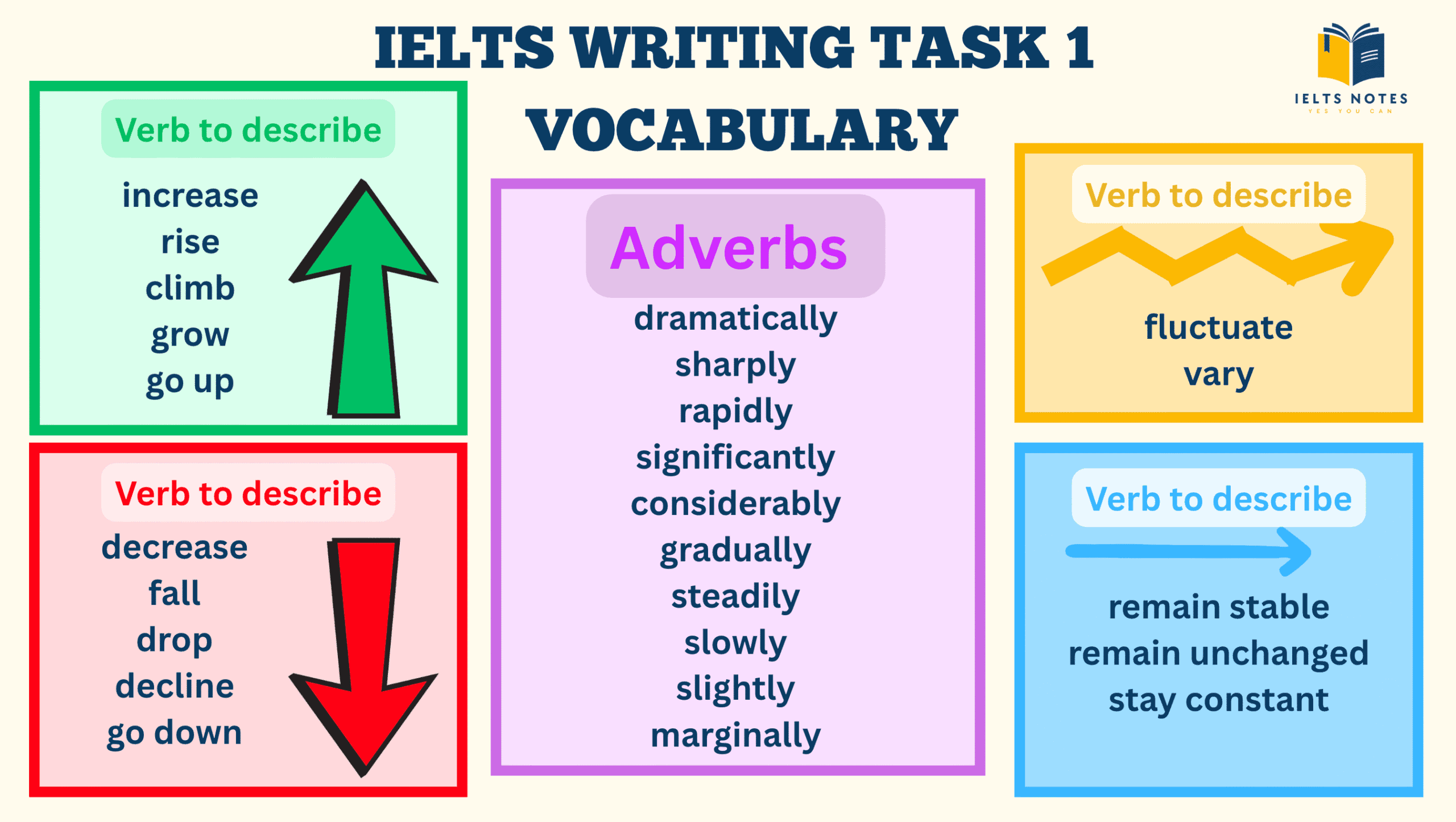
I’ve turned this into a quick PDF guide (yep, that’s the one in the picture 👇).
Just download it below and keep it for your IELTS study sessions!
