

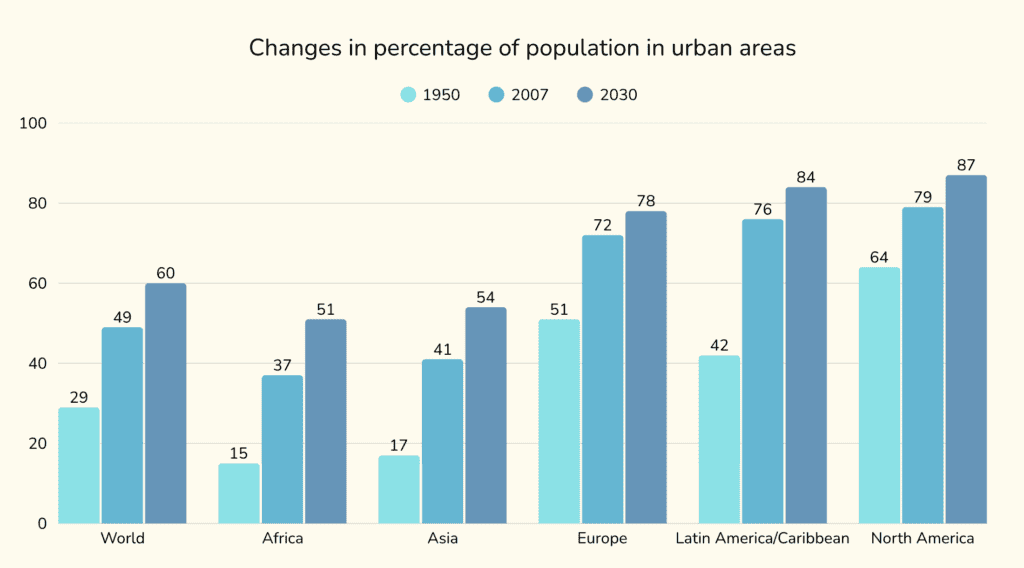
The bar chart below gives information about the percentage of the population living in urban areas in the whole world and in different parts of the world in three years.
Introduction
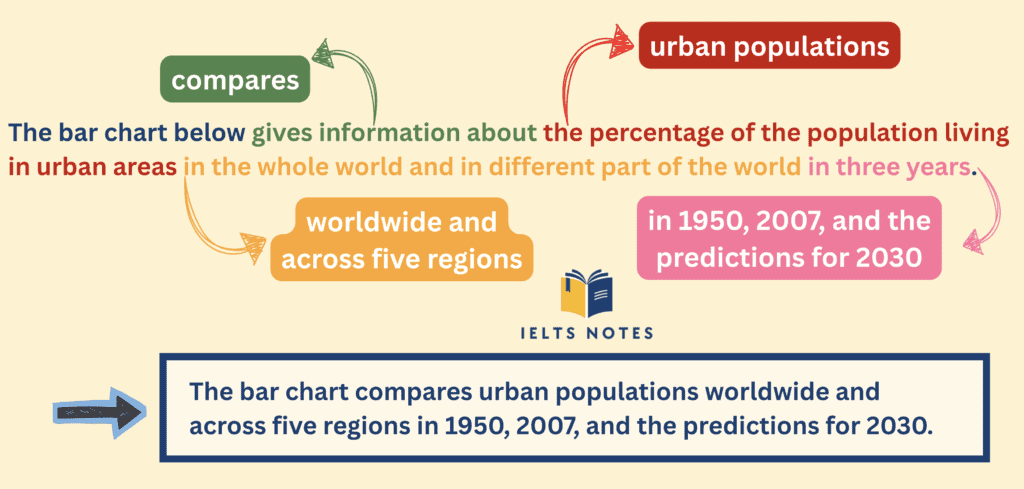
For the introduction, you only need to paraphrase the task question.
Read more
Overview
→ Overview:
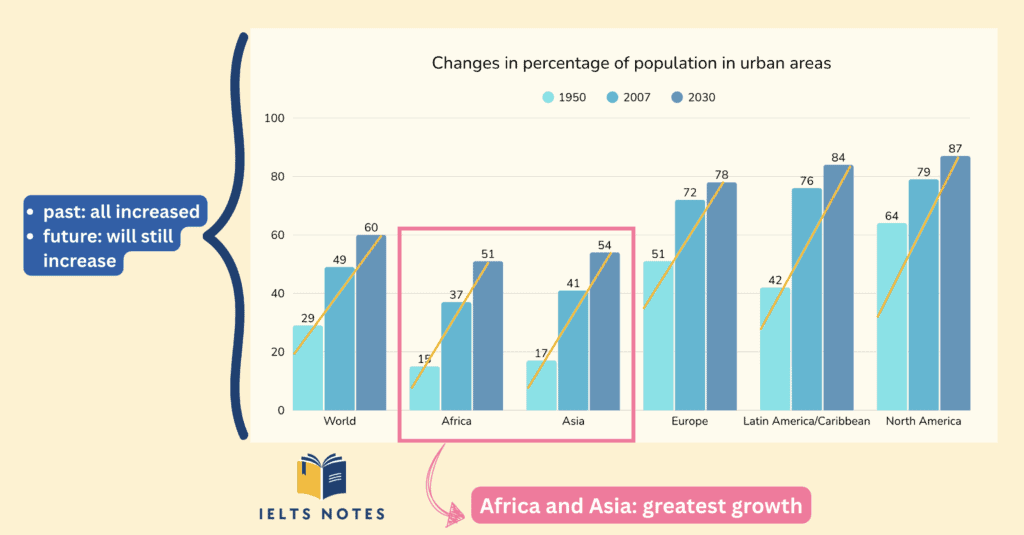
Overall, urbanization rose substantially in every region between 1950 and 2007, and this upward trend is expected to continue, with Africa and Asia projected to experience the greatest growth.
Plan your answer

Read more
Sample Answer
The bar chart compares urban populations worldwide and across five regions in 1950, 2007, and the predictions for 2030. Overall, urbanization rose substantially in every region between 1950 and 2007, and this upward trend is expected to continue, with Africa and Asia projected to experience the greatest growth.
In 1950, North America was the most urbanized region, with 64% of residents living in cities, followed by Europe, at 51%. By contrast, Africa and Asia had the lowest proportions, at only 15% and 17%, respectively. The figures for Latin America, Oceania and the global average fell between those extremes, ranging from 29% to 42%.
By 2007, urbanization had increased sharply in most areas. The proportions of city dwellers in Africa and Asia had approximately doubled, reaching 37% and 41%, respectively, and the world average had also risen to 49%. By this time, the vast majority of the population, ranging from 72% to 79%, in the other three regions lived in cities.
By 2030, over half of the population in every region is estimated to be living in urban areas, with North America remaining at the top, with 87%, Latin America and the Caribbean close behind, at 84%, and Europe ranking third, at 78%. While Africa and Asia are expected to remain the least urbanised, their figures will increase to 51% and 54%, whereas the global figure will reach 60%.
Useful Vocabulary
- urban population = the number or proportion of people living in cities rather than rural areas
- urbanization = the process of an increasing share of the population moving into or living in cities
- city dwellers = people who live in urban areas or cities
- ranged from … to … = varied between two specific values
- approximately doubled = became about twice as large as before
- predicted/ projected = expected to happen in the future based on current trends or data
- remain the least urbanised = continue to have the lowest share of people living in cities
- vast majority = nearly all of the people in a group
- at the top = having the highest value compared with other categories
- fell between = positioned within a middle range between two extremes
For the introduction, you only need to paraphrase the task question. Where is the task question?
Thanks for your comment 😊
The task question is:
“The bar chart below gives information about the percentage of the population living in urban areas in the whole world and in different parts of the world in three years.”
The introduction in the post is a paraphrased version of this question, as required in IELTS Writing Task 1.