

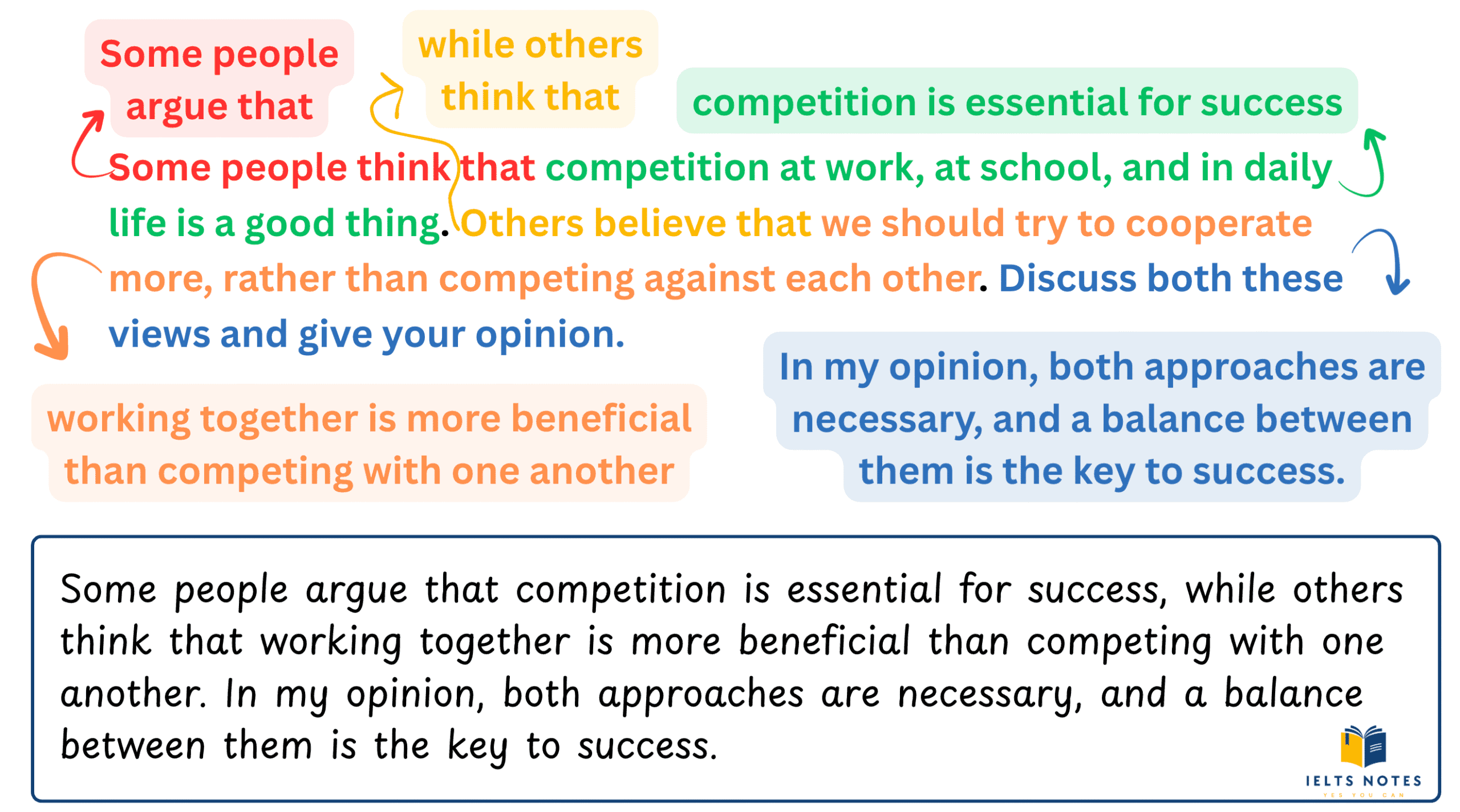
Some people think that competition at work, at school, and in daily life is a good thing. Others believe that we should try to cooperate more, rather than competing against each other. Discuss both these views and give your opinion.
Introduction
When you write your IELTS essay, start with an introduction by paraphrasing the question. What does that mean? It means you say the same idea in a different way.
Plan your answer
Before you start writing, don’t rush. Spend around 5 to 8 minutes planning your essay.
- First, decide clearly what your opinion is.
- Next, choose two strong points to support that opinion.
- But don’t stop there — for each point, think of one or two supporting ideas, like an example, an explanation, or a real-life situation.
Body paragraphs
Once your plan is ready, it’s time to expand it into proper paragraphs. Think of your plan as the backbone, and now you’re filling it out.
- Start with a clear topic sentence that states the main idea.
- Then, develop it with an explanation.
- Finally, support it with an example or evidence.


Sample Answer
Some people argue that competition is essential for success, while others think that working together is more beneficial than competing with one another. In my opinion, both approaches are necessary, and a balance between them is the key to success.
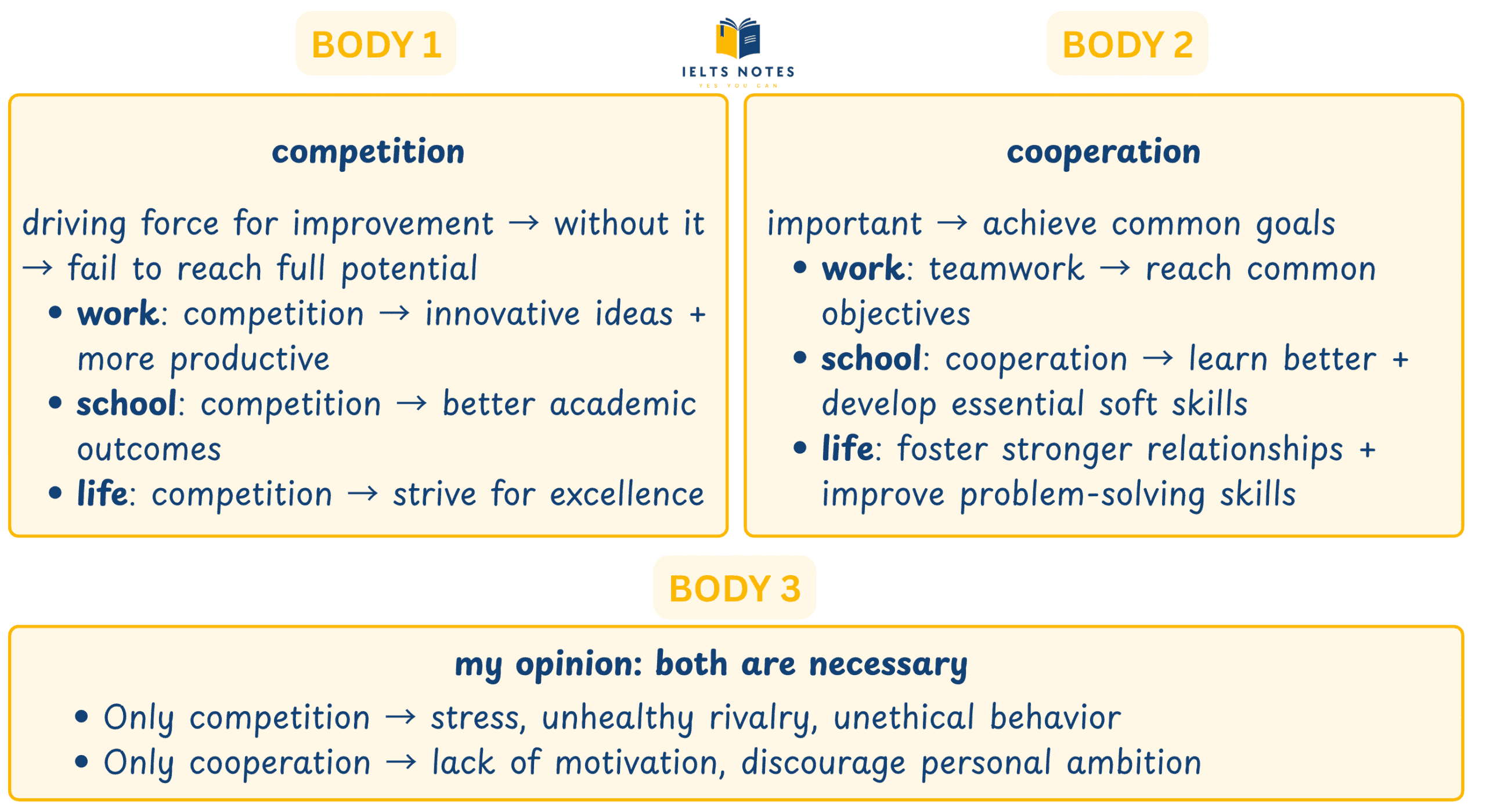
On the one hand, competition is often seen as a driving force for improvement. Without it, people may lack the motivation to push themselves beyond their comfort zones and fail to realize their full potential. For instance, in the workplace, employees who compete for a higher position are more likely to come up with innovative ideas and become more productive. Similarly, in schools, healthy rivalry among students encourages them to study harder and achieve better academic outcomes. Even in daily life, competing in sports or personal challenges, such as those related to health and fitness, can inspire people to strive for excellence and achieve things they might otherwise ignore.
On the other hand, cooperation is equally vital because many achievements cannot be accomplished by one person alone. In professional settings, teamwork enables individuals to pool their strengths and resources to reach common objectives, such as launching a new product or running a successful business campaign. In education, students who work collaboratively on group projects not only learn the subject matter more effectively but also develop essential soft skills, like communication and empathy. Likewise, in daily life, cooperating with family members or neighbors helps foster stronger relationships and makes problem-solving more effective.
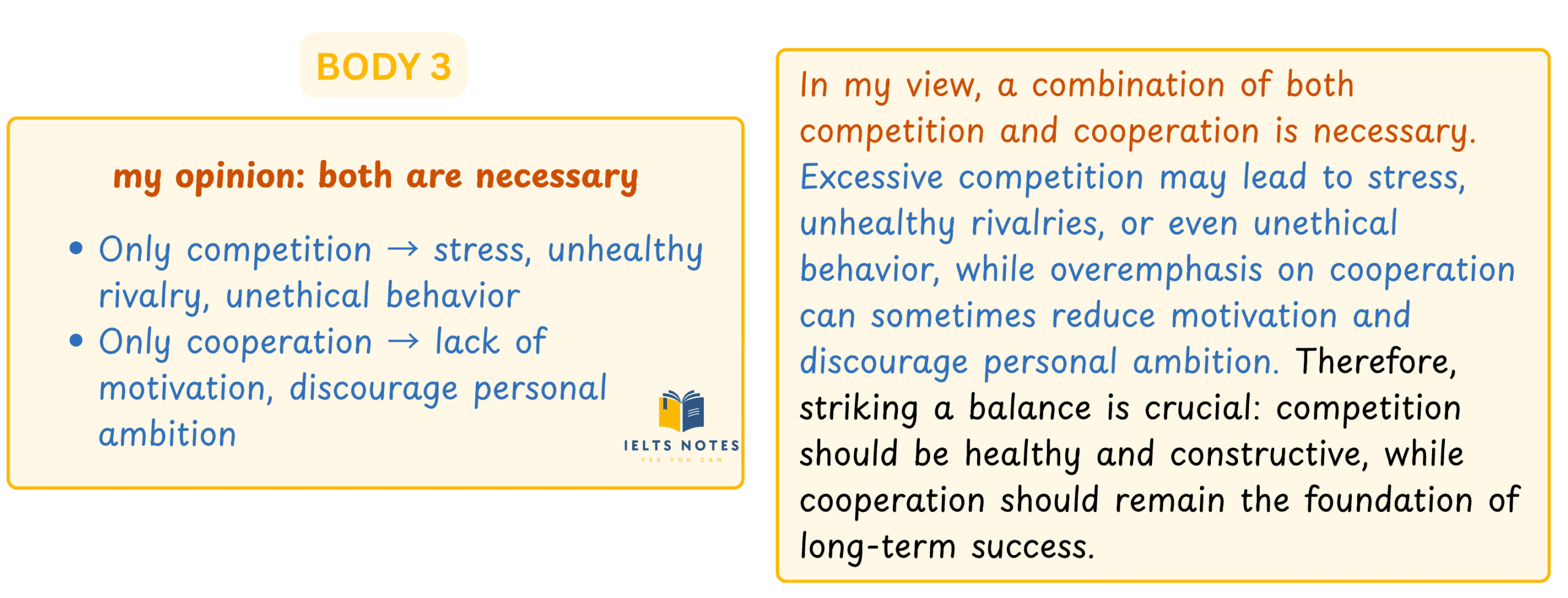
In my view, a combination of both competition and cooperation is necessary. Excessive competition may lead to stress, unhealthy rivalries, or even unethical behavior, while overemphasis on cooperation can sometimes reduce motivation and discourage personal ambition. Therefore, striking a balance is crucial: competition should be healthy and constructive, while cooperation should remain the foundation of long-term success.
In conclusion, competition motivates people to maximize their potential, whereas cooperation enables them to achieve common goals more effectively. I believe both are essential, and the key lies in maintaining a healthy balance between the two.
Useful vocabulary
- the key to = the essential element needed to achieve something
- a driving force = a strong factor that makes something happen or progress
- lack = not have enough of something
- full potential = the highest level of ability someone can achieve
- healthy rivalry = friendly competition that encourages improvement
- strive for excellence = try very hard to achieve the best quality or performance
- common objectives = shared goals or targets
- work collaboratively = work together with others in a cooperative way
- foster = encourage or develop something (e.g., skills, relationships)
- excessive = too much, more than is reasonable
- unethical behavior = actions that are morally wrong or dishonest
- overemphasis on = giving too much importance to something
- maintaining a healthy balance = keeping a fair and appropriate level between two things