

Multiple Choice is one of the most frequently appearing question types in the IELTS Reading test, yet it is also one of the most challenging for many students.
Some students are able to understand the passage and recognise familiar keywords, but still choose the wrong answer – or hesitate between similar options without knowing which one to eliminate.
The issue often does not lie in vocabulary range or general reading ability, but in the way the question type is approached.
Multiple Choice questions do not simply test how much information you remember; they assess your ability to analyse the question carefully, match information accurately, and eliminate distractors.
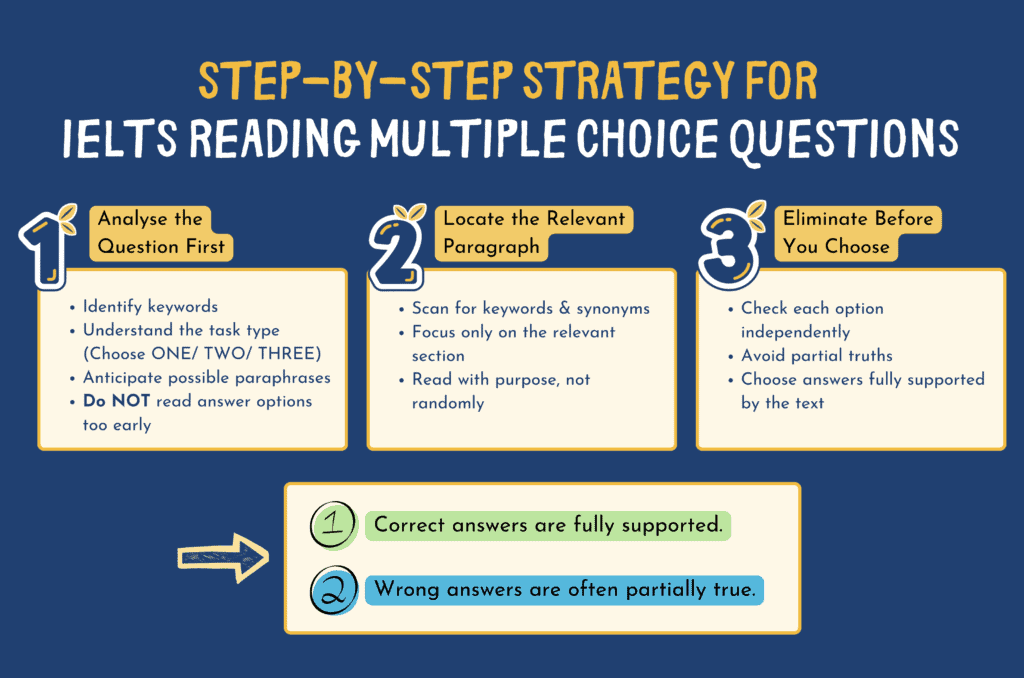
Understanding Multiple Choice in IELTS Reading
What Is the Multiple Choice Question Type?
Multiple Choice is a common question type in the IELTS Reading test. Although it may appear “easier” at first glance because the answers are provided, it is actually one of the most error-prone sections.
The options are often carefully designed to distract candidates: several choices may contain familiar keywords, appear partially correct, or sound logical but are not fully supported by the passage.
Therefore, performing well in IELTS Reading Multiple Choice requires more than basic comprehension. You need to read with a clear purpose and verify information logically before selecting an answer.
Read more
Common Types of Multiple Choice Questions in IELTS Reading
In the IELTS Reading test, Multiple Choice does not come in just one format. Identifying the question type correctly from the beginning helps you decide whether to focus on specific details or the overall main idea. This prevents you from applying the wrong strategy to the wrong type of question.
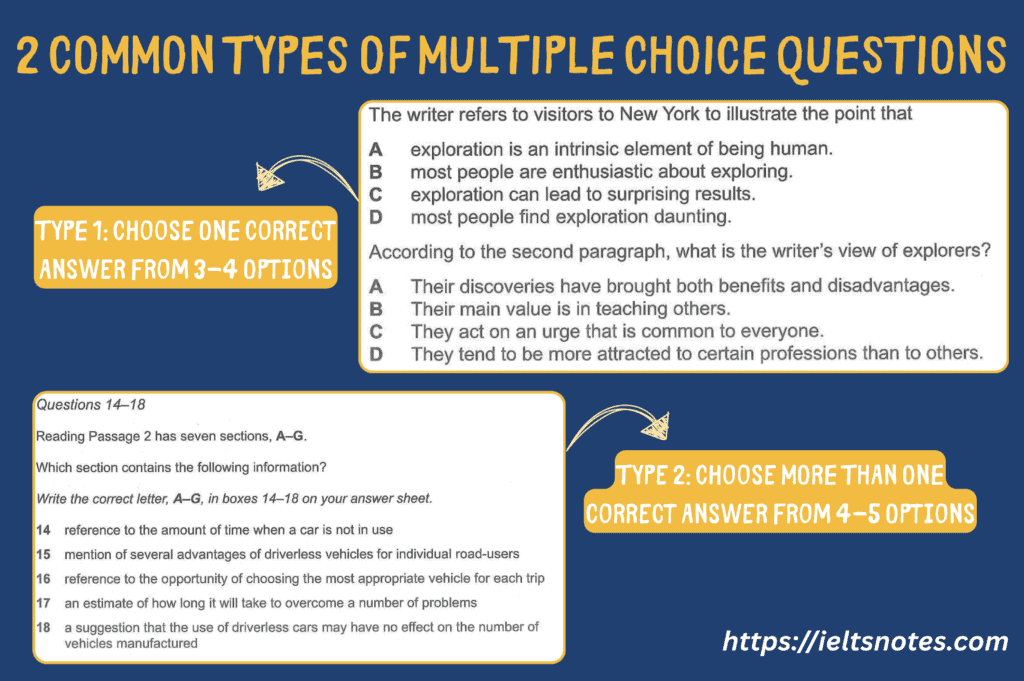
Type 1: Choose ONE Correct Answer from 3-4 Options
This is the most common format in IELTS Reading Multiple Choice questions. You are given three or four options and asked to select one correct answer.
Typically, the options fall into one of the following categories:
- An option that contains keywords but is not actually relevant to the passage
- An option that contradicts the information in the text
- An option that includes information mentioned in the passage but does not answer the question
- The one fully correct answer
Because the options are often paraphrased and strategically structured, skimming too quickly or choosing based on what “sounds familiar” can easily lead to mistakes.
For this question type, the most important step is to read the question carefully and verify each option against the actual content of the passage, rather than relying on first impressions.
Read more
Type 2: Choose MORE THAN ONE Correct Answer from 4-5 Options
In this format, you are given four or five options and asked to select two (or more than one) correct answers, depending on the instructions.
Compared to the single-answer format, this type can be even more confusing. Not only do you need to identify the correct answers, but you must also avoid selecting extra options and make sure you do not miss any correct ones.
The options are designed in a similar way to the single-answer type: they often contain familiar keywords, sound reasonable, and may even be partially correct. If you rely on intuition or check the answers superficially, you may end up choosing one correct option and one “almost correct” option.
Step-by-Step Strategy for IELTS Reading Multiple Choice Questions
To show you how to apply a clear Multiple Choice strategy in practice, I will use an example from a real test: Cambridge IELTS 15 – Test 1.
This is the second Multiple Choice format, where candidates are required to choose two challenges related to the development of automated vehicles.
Paragraphs:
Automation may prompt other changes in vehicle manufacture. If we move to a model where consumers are tending not to own a single vehicle but to purchase access to a range of vehicle through a mobility provider, drivers will have the freedom to select one that best suits their needs for a particular journey, rather than making a compromise across all their requirements.
Since, for most of the time, most of the seats in most cars are unoccupied, this may boost production of a smaller, more efficient range of vehicles that suit the needs of individuals. Specialised vehicles may then be available for exceptional journeys, such as going on a family camping trip or helping a son or daughter move to university.
There are a number of hurdles to overcome in delivering automated vehicles to our roads. These include the technical difficulties in ensuring that the vehicle works reliably in the infinite range of traffic, weather and road situations it might encounter; the regulatory challenges in understanding how liability and enforcement might change when drivers are no longer essential for vehicle operation; and the societal changes that may be required for communities to trust and accept automated vehicles as being a valuable part of the mobility landscape.
Question:
Questions 25-26
Choose TWO letters, A-E.
Write the correct letters in boxes on your answer sheet.
Which TWO challenges to automated vehicle development does the writer mention?
- A: making sure the general public has confidence in automated vehicles
- B: managing the pace of transition from conventional to automated vehicles
- C: deciding how to compensate professional drivers who become redundant
- D: setting up the infrastructure to make roads suitable for automated vehicles
- E: getting automated vehicles to adapt to various different driving conditions
Step 1: Analyse the Question Carefully Before Reading the Passage
In the first step, you should not jump straight to reading options A, B, C, and D. Reading the answer choices too early can easily “lead” you – the keywords in the options may bias your thinking and cause you to look for information in the wrong direction.
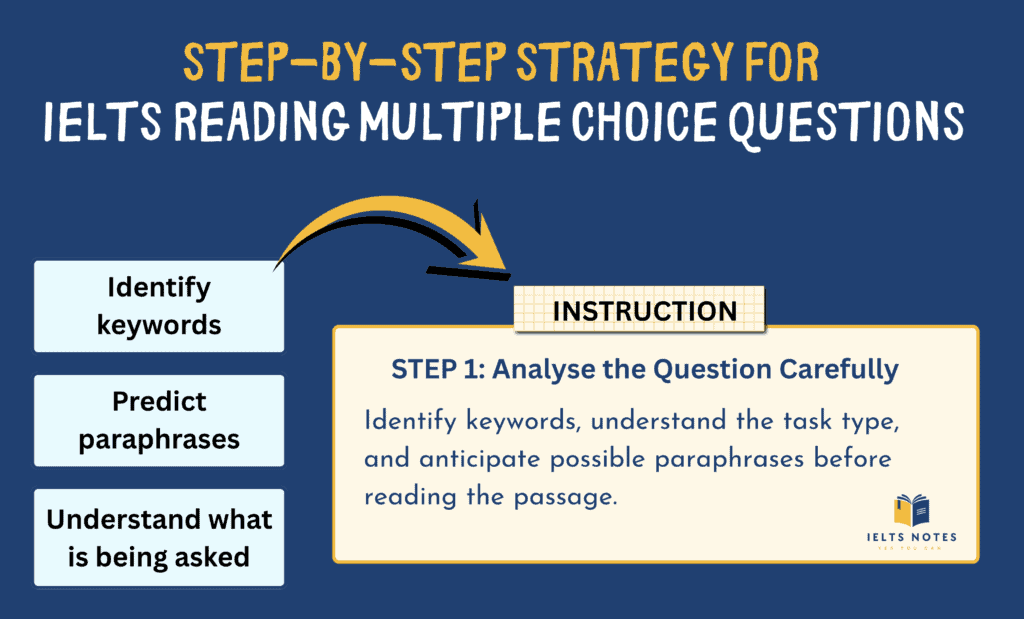
Instead, start by reading the question carefully and making sure you understand exactly what it is asking.
Illustrative Example
Let’s look at the following question from the test:
Which TWO challenges to automated vehicle development does the writer mention?
- TWO → You must select exactly two answers.
- challenges → The question is asking about difficulties or obstacles.
- automated vehicle development → This is the main topic.
- does the writer mention → Only choose information that is explicitly stated in the passage, not something inferred or assumed.
When we return to the passage, we find the sentence:
There are a number of hurdles to overcome in delivering automated vehicles to our roads.
Here:
- “hurdles” = “challenges”.
- “delivering automated vehicles to our roads” = “automated vehicle development”.
This is precisely the goal of Step 1: to identify exactly what you are looking for before examining the answer choices. If you read options A-E too early, you may become distracted by the wording of each option instead of focusing on the core requirement of the question.
Step 2: Locate the Relevant Information in the Passage
After you have analysed the question and identified the key keywords, the next step is to return to the passage and find the section that contains the relevant information.
At this stage, you do not need to read the entire text from beginning to end. Instead, you should read with direction, guided by the keywords you have already identified.
In this step, you should:
- Scan the passage to find the keywords or their synonyms/paraphrases.
- Focus on the paragraph(s) where these paraphrased phrases appear.
- Avoid reading the whole passage in detail – only read closely where the answers are most likely to be found.
- Remember that in IELTS Reading, answers usually appear in order, so you can often predict the approximate location of the information.
The key point of this step is: you are reading to locate the relevant paragraph, not to choose the answer immediately.
Illustrative Example
Let’s return to the question:
Which TWO challenges to automated vehicle development does the writer mention?
In Step 1, we identified the main keywords:
- challenges
- automated vehicle development
When scanning the passage, we find the following paragraph:
There are a number of hurdles to overcome in delivering automated vehicles to our roads. These include the technical difficulties in ensuring that the vehicle works reliably in the infinite range of traffic, weather and road situations it might encounter; the regulatory challenges in understanding how liability and enforcement might change when drivers are no longer essential for vehicle operation; and the societal changes that may be required for communities to trust and accept automated vehicles as being a valuable part of the mobility landscape.
At this point, we have successfully located the relevant paragraph without reading the entire passage.
Step 3: Analyse and Eliminate Options Using a Logical Strategy
After identifying the correct paragraph, your goal is not to immediately pick the correct answer. Instead, you should systematically eliminate the incorrect options. This method prevents you from choosing based on intuition and helps reduce confusion between answer choices that appear very similar.
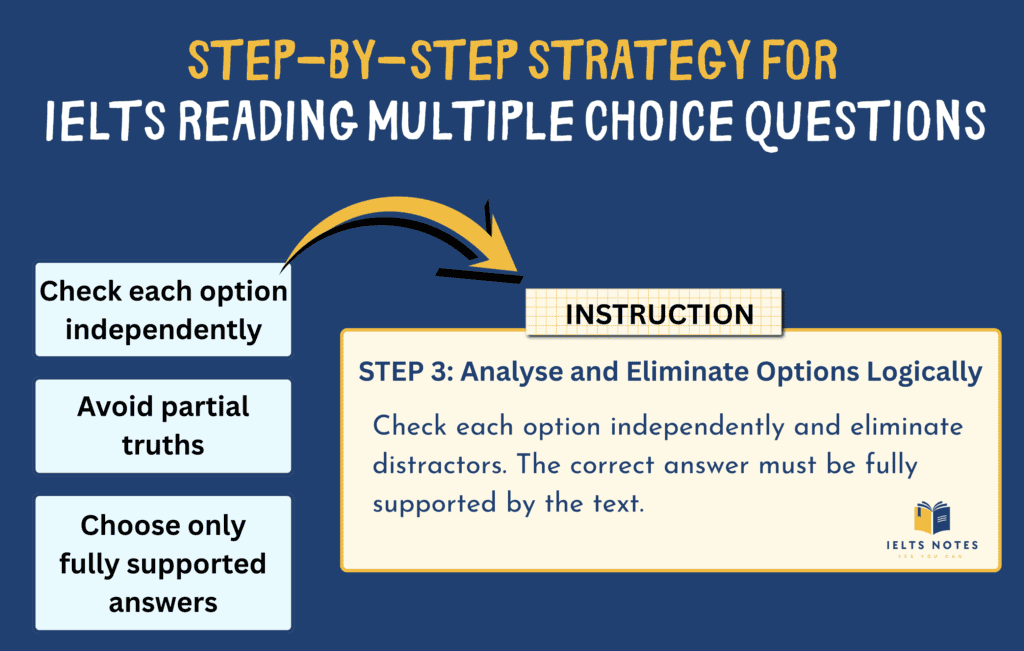
The most important principle in Step 3 is this: The correct answer must be completely accurate according to the passage. Incorrect options are often only partially true, involve additional inference, or contain subtle shifts in meaning.
Let’s return to the question:
Which TWO challenges to automated vehicle development does the writer mention?
We have already identified the relevant paragraph:
There are a number of hurdles to overcome in delivering automated vehicles to our roads. These include the technical difficulties in ensuring that the vehicle works reliably in the infinite range of traffic, weather and road situations it might encounter; the regulatory challenges in understanding how liability and enforcement might change when drivers are no longer essential for vehicle operation; and the societal changes that may be required for communities to trust and accept automated vehicles as being a valuable part of the mobility landscape.
Now, let’s analyse each option A–E systematically.
A. making sure the general public has confidence in automated vehicles
The passage states:
societal changes that may be required for communities to trust and accept automated vehicles…
The phrase “trust and accept” clearly corresponds to “has confidence in”. This is a reasonable paraphrase, and the information is explicitly stated in the text. Therefore, A is correct.
B. managing the pace of transition from conventional to automated vehicles
The identified paragraph does not mention anything about managing the speed of transition from traditional to automated vehicles. There is no reference to the “pace of transition.” Therefore, B is not mentioned.
C. deciding how to compensate professional drivers who become redundant
The passage does not discuss compensation for drivers who may lose their jobs. While this may seem like a logical real-world issue, it is not stated in the paragraph. Therefore, C is an inference and is not supported by the text.
D. setting up the infrastructure to make roads suitable for automated vehicles
The paragraph mentions technical difficulties, regulatory challenges, and societal changes, but it does not refer to building or modifying road infrastructure. Therefore, D is not mentioned in the passage.
E. getting automated vehicles to adapt to various different driving conditions
The passage states:
technical difficulties in ensuring that the vehicle works reliably in the infinite range of traffic, weather and road situations it might encounter…
This can be paraphrased as:
- “works reliably in traffic, weather and road situations” → “adapt to various different driving conditions”
This is a clear paraphrase, and the idea is explicitly supported by the passage. Therefore, E is correct.
Conclusion
Multiple Choice in IELTS Reading is not an “easy” question type simply because the answers are provided. It is designed to test your ability to analyse information and eliminate distractors.
REMEMBER: The correct answer will always be fully supported by the passage, while incorrect options are often partially true, involve additional inference, or contain subtle changes in meaning.
Hopefully, after reading this article, you will approach Multiple Choice questions more strategically and confidently in your IELTS Reading practice.