

IELTS Speaking Part 2 requires you to speak continuously for about 1–2 minutes on a given topic.
The problem usually lies not only in vocabulary range or pronunciation, but in the way you expand your answers. IELTS Speaking Part 2 does not assess how many ideas you can mention; instead, it evaluates how well you can develop one idea clearly, logically, and cohesively.
In this article, I will share some tips on expanding ideas effectively in IELTS Speaking Part 2. These strategies will help you build answers that are long enough, well-developed, and aligned naturally with the Fluency & Coherence criteria.
IELTS Speaking Part 2: Assessment Criteria
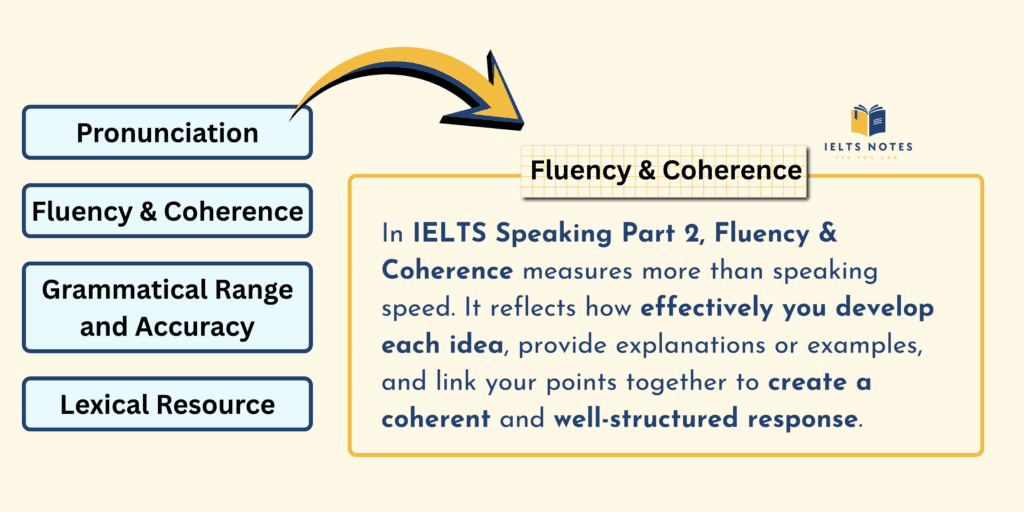
In the article How IELTS Scores Are Calculated? (Official Band Score Guide), I provided a detailed explanation of the IELTS Speaking marking criteria. Since IELTS Speaking Part 2 is a component of the Speaking test, it is assessed based on the same four core criteria:
- Pronunciation: This criterion evaluates the clarity and naturalness of your pronunciation, including intonation and word stress.
- Fluency & Coherence: This measures your ability to speak smoothly, maintain a clear flow of ideas, and connect them logically.
- Grammatical Range and Accuracy: This assesses the variety and accuracy of your grammatical structures.
- Lexical Resource: This evaluates your vocabulary range and your ability to use words appropriately and flexibly in context.
Read more
Why Do you Struggle to Expand your Ideas in IELTS Speaking Part 2?
Below are three common reasons why many students struggle to expand their responses naturally and coherently.
| Problems | Common mistakes |
| Staying at a Surface Level (“What” Only) | Students simply describe the person or event without adding further detail. For example: “He is my teacher. He is very kind.” |
| Not Knowing How to Develop Ideas Further (Why – How – Feelings – Results) | Students mention the main idea but fail to explain why, provide examples, describe their feelings, or discuss the outcome. |
| Lack of a Clear Expansion Structure | Students speak spontaneously without a clear direction, saying whatever comes to mind. |
4 KEY Frameworks to Expand Ideas in IELTS Speaking Part 2
In this section, I will introduce four practical strategies to help you develop your answers logically and naturally. Each framework comes with practical guidance, enabling you not only to speak for the full time, but also to develop your ideas with depth and clarity.
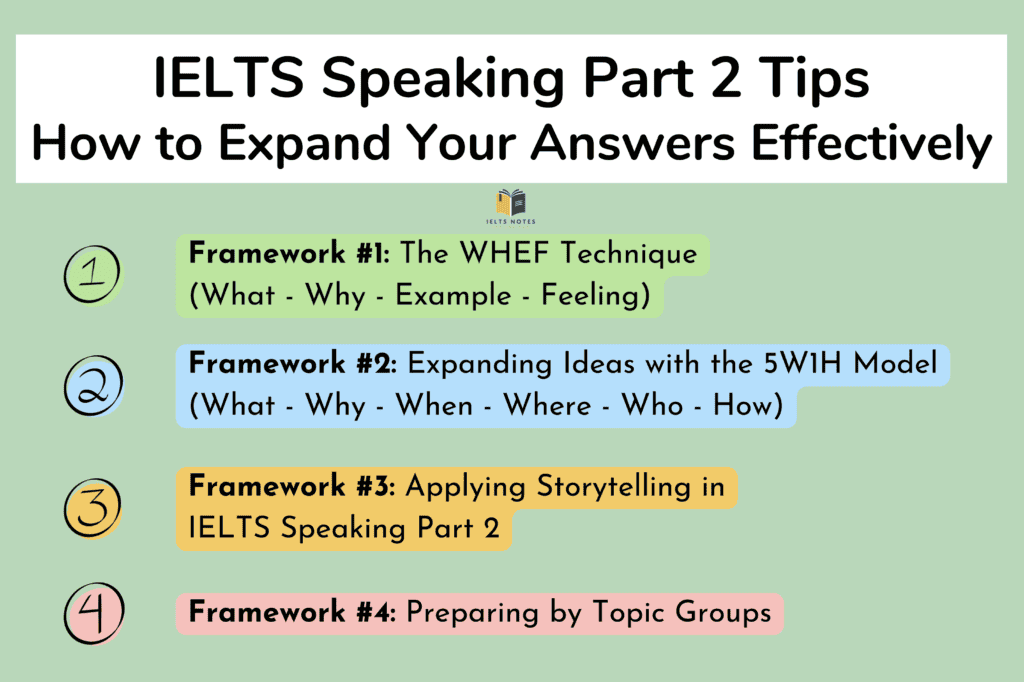
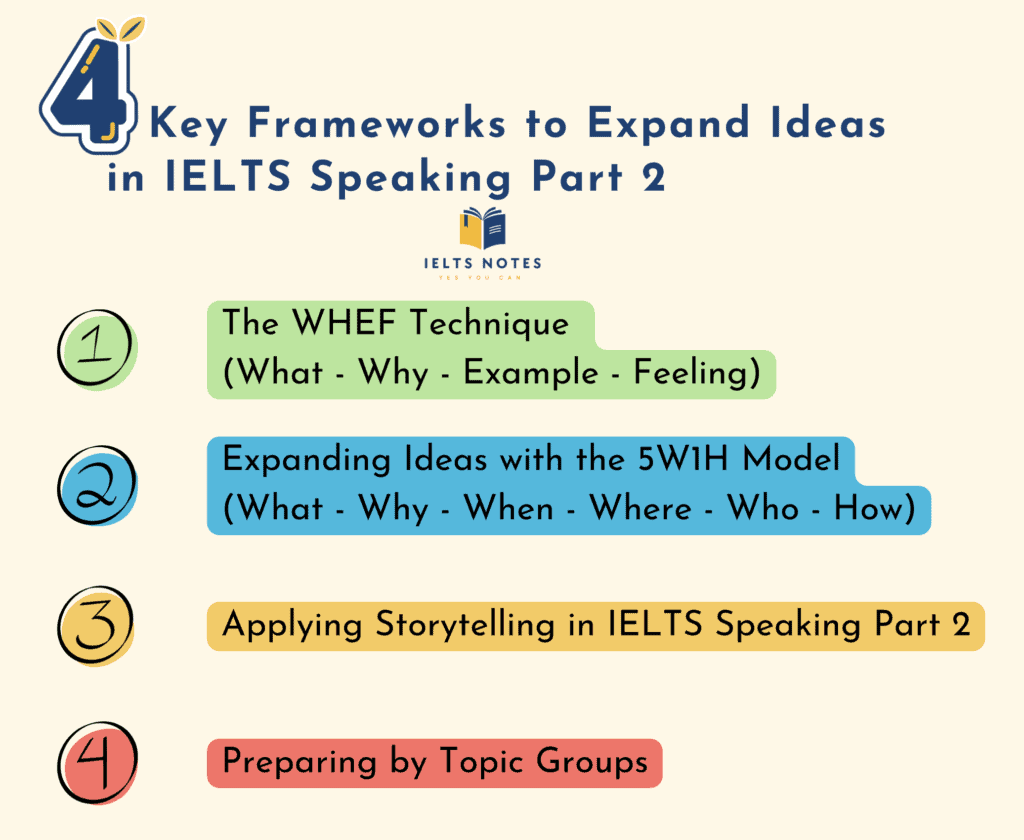
The four frameworks include:
- The WHEF Technique (What – Why – Example – Feeling)
- Expanding Ideas with the 5W1H Model
- Applying Storytelling Elements
- Preparing by Topic Groups
Framework #1: The WHEF Technique (What – Why – Example – Feeling)
WHEF is a structured technique that helps you develop an idea logically instead of stopping at surface-level description. Specifically:
- What – What are you talking about?
- Why – Why is it important or worth mentioning?
- Example – Is there a specific example that illustrates this idea?
- Feeling – How do you feel about it?
Many students stop at the “What” stage. However, to achieve a high score, your ideas need to be expanded, explained, and clearly connected.
When developing an idea in your answer, you can guide yourself with the following questions:
- What exactly am I talking about?
- Why is this important or memorable?
- Is there a specific situation or example that supports this?
- How do I feel about it?
You do not need to separate these four elements into four distinct sentences. Instead, they should flow naturally as part of one coherent idea.
Example: Describe one of your best friends
In the sample answer for Describe one of your best friends on IELTS Notes, the response about Finn does not simply describe him as “curious” or “kind-hearted.” Instead, the idea is developed clearly following the spirit of the WHEF framework.
“What I really admire about Finn is his personality. He’s incredibly curious – the kind of person who always asks questions in class or reads science books just to find answers.”
Analysed using the WHEF framework:
- What: Finn is incredibly curious.
- Why: This is an admirable quality.
- Example: He always asks questions in class and reads science books to find answers.
- (Implied Feeling): The speaker expresses admiration through the tone and wording.
A clearer illustration appears in the concluding part of the answer:
“The main reason Finn is one of my best friends is that he has always stood by my side through thick and thin… His support means the world to me.”
WHEF breakdown:
- What: He has always stood by my side.
- Why: That is the main reason he is my best friend.
- Example: We have gone through both good and difficult times together.
- Feeling: His support means the world to me.
As you can see, each idea is fully developed instead of being limited to a single descriptive sentence. As a result, the response does not feel abrupt or disconnected, and it maintains a natural flow throughout the two-minute speaking time.
The WHEF framework helps you speak more deeply, more clearly, and more directly to the point.
You can read the full sample answer HERE.
Read more
Framework #2: Expanding Ideas with the 5W1H Model (What – Why – When – Where – Who – How)
The 5W1H model is a questioning framework commonly used in academic writing and analytical thinking. It consists of:
- What – What happened?
- Why – Why did it happen, or why is it important?
- When – When did it happen?
- Where – Where did it take place?
- Who – Who was involved?
- How – How did it happen?
When you receive a cue card, instead of asking yourself, “What should I say?”, try asking:
- When did this happen?
- Who was involved?
- Why was it memorable or important?
- How did it affect me?
You do not need to answer all six questions in strict order. However, using this framework as a mental guide can help you expand your response in a structured and coherent way.
Example: Describe a gift that you recently gave to someone
In the sample answer for Describe a gift that you recently gave to someone, the response does not simply state, “I gave her a book.” Instead, the idea is developed using multiple elements of the 5W1H framework.
- WHAT: A self-help book
I gave my best friend, Emma, a self-help book.
The speaker clearly states what the gift was.
- WHO: Emma – my best friend
Recently, I gave my best friend, Emma, a personal birthday gift – a self-help book… My friend and I have been through a lot together, sharing both our triumphs and struggles.
The answer adds background about who Emma is and the relationship they share, giving the response more emotional depth.
- WHEN: Recently
Recently, I gave my best friend, Emma, a personal birthday gift…
The time reference provides context and makes the story more specific.
- WHY: The reason for giving the book
She had faced a number of challenges… I wanted to give her something that would help her navigate this challenging period.
Here, the speaker explains the motivation behind the gift, which adds meaning and purpose to the answer.
- HOW: The way the gift was given
When I gave my friend the book, I made sure to write a note inside. I told her how much I admired her strength, resilience, and the way she always pushed through difficult times.
This detail makes the answer more vivid and personal.
The response goes even further by expanding on the impact and significance of the gift:
It was more than just a birthday present; it was a reminder that I believe in her.
By incorporating multiple elements of 5W1H, the speaker develops the idea naturally and meaningfully. The answer becomes more structured, detailed, and emotionally engaging, rather than simply listing facts.
You can read the full sample answer HERE.
Framework #3: Applying Storytelling in IELTS Speaking Part 2
Storytelling means structuring your answer like a short narrative with context, development, and emotion. Instead of simply stating what happened, you place the event within a sequence of cause – development – outcome. This helps:
- Maintain a more natural flow of speech
- Improve logical connections between ideas
- Demonstrate Fluency & Coherence more clearly
Examiners do not expect you to tell a dramatic story. However, when your response follows the structure of a small narrative, it becomes easier to follow and more coherent than a list of unrelated points.
When answering IELTS Speaking Part 2, you can organise your response into three basic stages:
- Context – In what situation did the event take place?
- Development – What happened? Why did you make that choice?
- Outcome & Reflection – What was the result? How did you feel about it?
This structure allows your answer to unfold naturally, rather than sounding like a collection of separate statements.
Example: Describe a gift that you recently gave to someone
In the sample answer for Describe a gift that you recently gave to someone on IELTS Notes, the response does not simply state, “I gave my friend a book.” Instead, the entire answer is structured like a short story.
- Context:
Over the past year, she had been feeling a bit stuck… she had faced a number of challenges.
The speaker sets the background by explaining the friend’s situation. This context helps the listener understand why the gift was meaningful in the first place.
- Development:
After thinking about it for a while, I settled on a book that had made a significant impact on my own life: Atomic Habits…
Instead of just naming the book, the speaker describes the thought process behind choosing it. This makes the idea unfold naturally and adds depth to the response.
- Outcome & Reflection:
For me, giving this book was more than just a birthday present… it was a reminder that I believe in her.
The ending does more than conclude the story. It highlights the emotional significance and deeper meaning of the action.
By organising the answer in this way, the response feels cohesive and engaging rather than like a list of disconnected ideas.
You can read the full sample answer HERE.
Framework #4: Preparing by Topic Groups
One common reason many students “run out of ideas” in IELTS Speaking Part 2 is that they practise each cue card separately. When they encounter a new topic in the exam, they have to think from scratch, which wastes time and often leads to hesitation.
This framework focuses on preparing ideas by broader topic groups rather than memorising individual answers. It is particularly effective for home practice because it helps you build an “idea bank” that can be flexibly adapted to different questions.
Most IELTS Speaking Part 2 topics can be grouped into the following categories:
- Person (Describe a person…)
- Place (Describe a place…)
- Object (Describe an object…)
- Situation (Describe a situation…)
- Event/ Activity (Describe an event or activity…)
- Your favourite… (Describe your favourite book/movie/subject…)
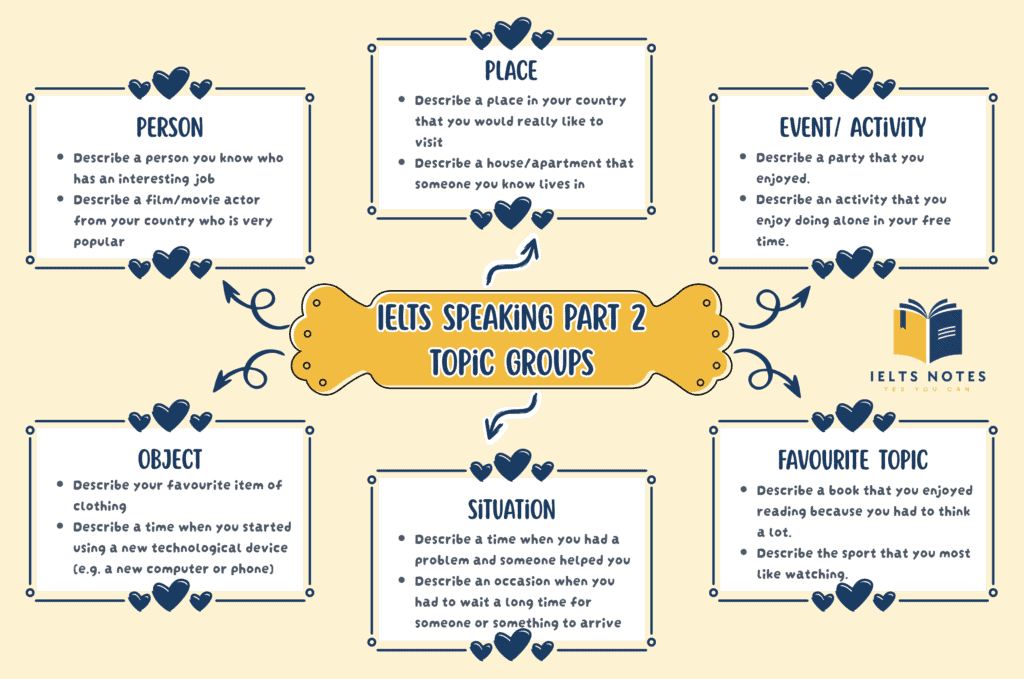
Instead of preparing 20–30 separate speeches, you only need to prepare one or two well-developed stories or personal experiences for each major category. These core ideas can then be adapted and expanded to suit a wide range of cue cards in the actual test.
How to Apply This Framework
Instead of practising isolated cue cards, you should build a structured idea-preparation system based on topic groups from the beginning of your Speaking preparation.
This approach includes three main directions:
- Build a Core “Story Bank”
For each major topic group (Person, Place, Object, Event, Situation, etc.), prepare one or two meaningful experiences that you understand clearly and can talk about fluently.
These stories should contain enough detail to be expanded from different angles, such as:
- Background or context
- Reasons
- Impact or results
- Feelings and reflections
A well-developed core story gives you flexibility and confidence during the test.
- Practise Shifting the Focus Based on the Question
The same story can be adapted in different ways depending on the cue card. For example, a close friend could become:
- Someone you admire (focus on qualities)
- Someone who helped you (focus on actions and impact)
- Someone you enjoy spending time with (focus on shared activities)
Training yourself to shift the focus helps you stay flexible instead of relying on a fixed version of a memorised answer.
- Combine Topic Preparation with Expansion Frameworks
Preparing by topic groups helps you control the content. However, to achieve a high score in IELTS Speaking Part 2, you still need to know how to expand and connect ideas effectively while speaking.
When you combine these two factors, your response will have both solid content and a clear structure:
- A strong idea bank
- Clear expansion frameworks (such as WHEF, 5W1H, and Storytelling)
From a long-term self-study perspective, this approach is more sustainable than memorising individual sample answers. It allows you to stay in control of your ideas, feel more confident when facing new topics, and maintain a steady, coherent flow throughout your IELTS Speaking Part 2 response.
Read more
Conclusion
The four frameworks introduced in this article – WHEF, 5W1H, Storytelling, and preparation by topic groups — all aim to help you control the flow of your answer and ensure that each idea is fully developed.
If you would like to gain a deeper understanding of how IELTS Speaking is assessed or follow a structured preparation roadmap, you can explore related articles on IELTS Notes across Facebook, Tiktok, Youtube, and Pinterest to continue improving your skills in a sustainable and effective way.