

Hometown is one of the most frequently tested topics in IELTS Speaking, especially in Speaking Part 1 and Part 2. Candidates are almost certain to be asked about the place where they were born, grew up, or currently live, along with their personal feelings and impressions of that place.
To achieve Band 8 or higher, you need to use hometown-related vocabulary more naturally, combining it with appropriate collocations and personal perspectives rather than simply listing surface-level features.
In this article, you’ll learn Band 8+ IELTS Speaking vocabulary for the topic of Hometown, clearly organised into common categories that frequently appear in the exam. Each section is supported by practical sample answers to help you apply the vocabulary effectively in your IELTS Speaking test.
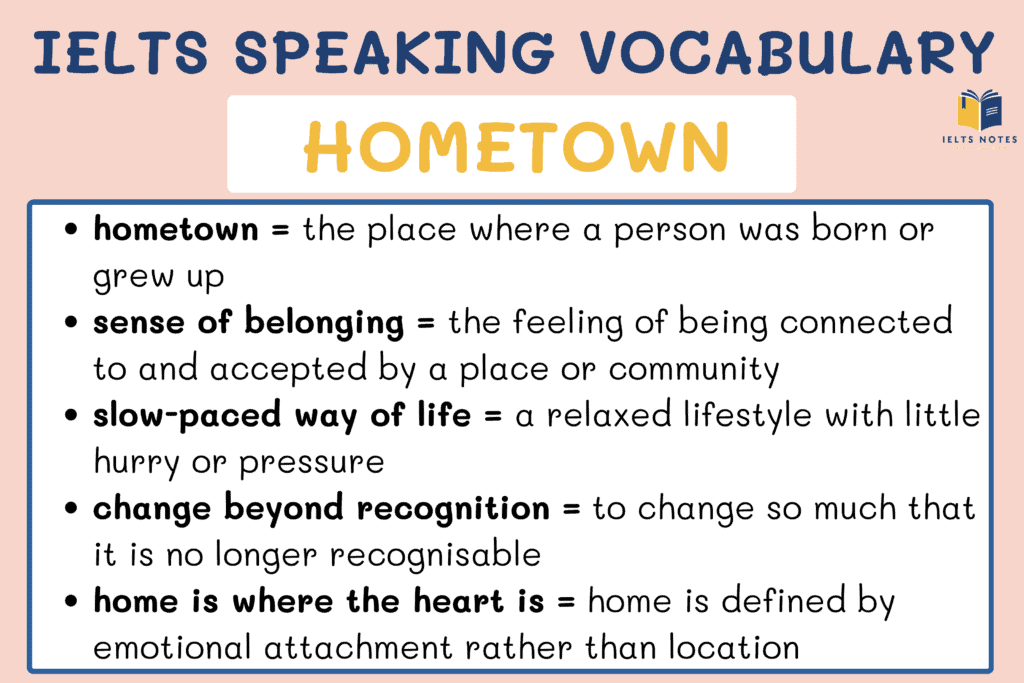
IELTS Speaking Hometown Vocabulary by Topics
General Hometown Vocabulary
- hometown = the place where a person was born or grew up
- place of origin = the place a person originally comes from (a more formal expression for hometown)
- residential area = a part of a city or town where people live
- neighbourhood = the local area surrounding a person’s home
- local community = the group of people living in the same area and sharing local connections
- living environment = the overall conditions of the area where people live, including surroundings and facilities
- urban area = a city or town with a high population and developed infrastructure
- rural area = the countryside, typically with fewer people and less development
- city centre = the central part of a city where business, shopping, and public facilities are concentrated
- outskirts = the outer areas or edges of a city or town
- population density = the number of people living in a specific area
- pace of life = the speed and rhythm of daily life in a particular place
- quality of life = the general level of comfort, well-being, and satisfaction experienced by residents
- sense of belonging = the feeling of being connected to and accepted by a place or community
- living conditions = the circumstances in which people live, including housing, services, and the environment
Places & Facilities in a Hometown
- public facilities = public buildings and services such as schools, hospitals, and libraries
- local amenities = facilities and services in an area that support everyday life
- shopping centre/ mall = a large building or complex with many shops and stores
- public park = an open green space accessible to everyone for relaxation and recreation
- recreational area = a place designed for leisure, exercise, or relaxation activities
- sports complex = a group of facilities designed for sports and physical activities
- community centre = a building used for social, cultural, and community activities
- public transport system = the network of buses, trains, or other transport used by the public
- bus routes = specific paths followed by buses as part of public transportation
- healthcare facilities = places that provide medical care and health services
- educational institutions = organisations such as schools, colleges, and universities that provide education
- cultural venues = places where cultural activities take place, such as theatres and museums
- local market = a traditional or community market where local products are sold
- pedestrian street = a street designed mainly for people to walk, not for vehicles
- essential services = basic services necessary for daily life, such as utilities and public support
Read more
Describing the Atmosphere & Lifestyle
- peaceful atmosphere = a calm and pleasant environment with little noise or disturbance
- fast-paced lifestyle = a way of life characterised by speed, pressure, and a busy daily routine
- laid-back lifestyle = a relaxed way of living with minimal stress or urgency
- close-knit community = a community in which people have strong, supportive relationships
- sense of community = a feeling of connection and shared identity among local residents
- hustle and bustle = lively activity and noise, especially in a busy city area
- quiet surroundings = an environment with little noise or disruption
- lively atmosphere = an energetic and active environment with many social activities
- balanced way of life = a lifestyle that maintains a healthy balance between work and personal time
- strong sense of belonging = a deep feeling of attachment and connection to one’s place of living
- everyday pace of life = the typical rhythm and speed of daily activities in a place
- relaxed environment = a comfortable and stress-free living environment
- stressful living conditions = living circumstances that cause pressure, anxiety, or strain
- traditional way of life = a lifestyle rooted in long-established customs and practices
- modern lifestyle = a contemporary way of living often associated with urban development and modern conveniences
Hometown Changes & Development
- rapid development = fast growth or progress over a short period of time
- urbanisation = the process of expanding and modernising cities and urban areas
- infrastructure development = the improvement and expansion of basic facilities such as roads, bridges, and public utilities
- significant changes = noticeable and important changes that have a clear impact
- population growth = an increase in the number of people living in a particular area
- improve living standards = to raise people’s quality of life and overall well-being
- modernisation = the process of becoming more modern through new technologies and systems
- economic growth = an increase in economic activity and overall wealth
- housing development = the construction and expansion of residential areas and housing projects
- expansion of the city = the physical growth of a city in size and area
- improved public facilities = upgraded public services and infrastructure for community use
- changes in lifestyle = shifts in the way people live, work, and spend their time
- loss of traditional features = the gradual disappearance of traditional characteristics or customs
- transform beyond recognition = to change so dramatically that it is hard to recognise compared to the past
- widen the gap between urban and rural areas = to increase the differences in development and living conditions between cities and countryside
Read more
Hometown-related Collocations
- grow up in a place = to spend one’s childhood and formative years in a particular location
- be born and raised in = to be born in a place and spend most of one’s early life there
- a place I call home = a place that feels like home and holds personal meaning
- have strong ties to = to feel closely connected or emotionally attached to something
- feel a strong sense of belonging = to feel deeply connected and accepted in a place or community
- play an important role in my life = to have a significant influence on one’s life
- shape a person’s personality = to influence the development of one’s character and traits
- offer a high quality of life = to provide good living conditions and overall well-being
- provide essential services = to supply basic services necessary for daily life
- be well-connected by public transport = to have convenient and efficient public transportation links
- undergo rapid changes = to experience fast and noticeable changes
- experience significant development = to go through major growth or improvement
- change dramatically over time = to alter greatly as time passes
- retain its traditional character = to preserve traditional features and cultural identity
- lose its original charm = to no longer have the attractiveness it once had
- strike a balance between tradition and modernity = to maintain both traditional values and modern developments
- face growing pressure = to deal with increasing challenges or demands
- attract more residents = to draw more people to live in a particular area
- become increasingly crowded = to grow more crowded as more people move in
- improve overall living conditions = to enhance general living standards and environments
Idioms & Natural Expressions about Hometown
- feel at home = to feel comfortable, familiar, and relaxed in a place
- a place close to my heart = a place that has special emotional meaning
- home is where the heart is = home is defined by emotional attachment rather than location
- a second home = a place that feels as familiar and comfortable as one’s main home
- come and go = to change frequently as people or situations move in and out
- change beyond recognition = to change so much that it is no longer recognisable
- stand the test of time = to last for a long time while retaining its value or importance
- have seen better days = to be in worse condition than in the past
- the heart of the city = the central and most lively part of a city
- a stone’s throw away = very close, within a short distance
- off the beaten track = not popular or not frequently visited by most people
- a breath of fresh air = something that feels new, refreshing, or different from the usual environment
- slow-paced way of life = a relaxed lifestyle with little hurry or pressure
- a tight-knit place = a place where people are closely connected and supportive
- far from perfect = not ideal and still having many limitations
- full of character = having distinctive features and personality
- lose its charm = to gradually stop being attractive or appealing
- bring back memories = to remind someone of past experiences or times
- a sense of roots = a feeling of connection to one’s origins or background
- where everything started = the place where one’s story or journey began
Phrasal Verbs Related to Hometown & Living Areas
- grow up = to spend one’s childhood and develop in a particular place
- move away = to leave a place in order to live somewhere else
- move back = to return to live in a place where one lived before
- settle down = to establish a stable, long-term life in one place
- come back = to return to a hometown or a place previously lived in
- build up = to develop or expand gradually over time
- pass down = to transfer traditions, values, or customs from one generation to another
- spring up = to appear or develop quickly, especially buildings or communities
- tear down = to demolish old buildings or structures to make way for new ones
- develop into = to gradually change and become a different form or state
- blend in = to fit in naturally with the surrounding environment or community
- stand out = to be clearly noticeable or different from others
- live on = to continue to exist, especially memories, traditions, or values
- spread out = to expand or extend over a wide area
- get around = to move from place to place within an area
- set up = to establish or build something, such as a residential area or facility
- grow into = to gradually become larger, more developed, or more advanced
- die out = to gradually disappear over time
- fill up = to become crowded or full of people
- slow down = to reduce speed, pace of life, or rate of development
Read more
IELTS Speaking Part 1: Topic – Hometown
Where is your hometown?
My hometown is in Waterloo, which is a relatively small city in Canada. It’s mainly a residential area, known for its universities and a peaceful atmosphere.
How long have you been living there?
I’ve lived there all my life, so I’m really familiar with the area. It’s a beautiful place, and I like the sense of community because people tend to know and look out for one another.
What do you like the most about your hometown?
What I like most about Waterloo is the people, without a doubt. Even though the city has developed a lot and has plenty of modern facilities, it still has a close-knit community, which makes it feel like home.
Do you think you will still be living in your hometown in the future?
Probably not in the short term. For work, I’ll most likely need to live in a bigger city because there are more career opportunities. However, if I continue working as a freelancer, I’d definitely consider moving back to my hometown in the future.
Useful Vocabulary:
- residential area = a part of a city or town where people live
- peaceful atmosphere = a calm and quiet environment with little noise or stress
- familiar with = knowing a place or situation well because of experience
- look out for = to care for, protect, or help someone
- without a doubt = used to show strong certainty or confidence
- close-knit community = a group of people who have strong relationships and support one another
- career opportunities = chances to find jobs or develop professionally
- moving back to = returning to live in a place where you lived before
IELTS Speaking Part 2: Describe your hometown
You should say:
- Where is it?
- What is special about it?
- What should tourists do there?
Explain whether it is an ideal place to live in or not.
Sample Answer:
I’d like to talk about my hometown, which is Waterloo, a city located in Canada. It’s not a huge city, but it has a rich history and has gradually developed into a modern place while still keeping its original character. I was born and raised there, so it plays an important role in my life.
What makes Waterloo special is the balance it strikes between tradition and modern life. It has a peaceful atmosphere, yet it also offers plenty of local amenities, such as universities, public parks, and community spaces. The pace of life there is quite comfortable – not too fast, not too slow – which makes daily life feel manageable and less stressful.
For tourists, I think the best thing to do is to explore the city on foot, spend time in the parks, and visit the local cafés and cultural venues. These places really reflect the local community and give visitors a sense of what everyday life is like. It’s not a typical tourist destination, but that’s exactly what makes it interesting – it feels authentic and welcoming.
Although I’ve moved away for study and work, I still believe Waterloo is an ideal place to live. It offers a good quality of life, a strong sense of belonging, and a supportive environment, especially for people who value stability and community over a fast-paced lifestyle.
Useful Vocabulary:
- be born and raised in = to be born in a place and spend most of one’s early life there
- peaceful atmosphere = a calm and pleasant environment with little noise or disturbance
- local amenities = facilities and services in an area that support everyday life
- pace of life = the speed and rhythm of daily life in a particular place
- explore the city on foot = walk around the city to discover places, streets, and attractions at a slow pace, allowing for a more detailed and authentic experience
- local community = the group of people living in the same area and sharing local connections
- move away = to leave a place in order to live somewhere else
- sense of belonging = the feeling of being connected to and accepted by a place or community
- fast-paced lifestyle = a way of living characterised by a busy schedule, constant activity, and a high level of time pressure, often associated with urban life and demanding work environments
IELTS Speaking Part 3: Topic – Hometown
Why do people have a very strong bond with their hometown?
I think one main reason is that people usually spend at least the first eighteen years of their lives in their hometown, which naturally creates deep emotional connections. It’s often the place where they were born and raised, where their family members live, and where many important memories were formed. Because of that, people tend to develop a strong sense of belonging and feel closely tied to the place they call home, even if they later move away.
In what ways can people improve their hometown?
I think there are many ways people can improve their hometown, but the key point is making sure that development goes hand in hand with social responsibility. For example, individuals can support local businesses, respect public spaces, and volunteer in community projects, which helps the town grow without losing its sense of community.
Which influences a person’s personality more, the hometown or the current city? Why?
I think both play a role, but personally, I believe a person’s hometown has a stronger influence. It’s where people form their core values and habits during childhood, which tend to stay with them even after they move away. Although living in a new city can shape lifestyle and attitudes, those early influences are usually more deeply rooted.
Useful Vocabulary:
- emotional connections = strong feelings of attachment or affection toward a place or people
- a strong sense of belonging = a deep feeling of being accepted and feeling like you are part of a place or group
- closely tied to = strongly connected or linked to something
- goes hand in hand with = happens together with something else and is closely connected to it
- sense of community = the feeling of closeness, support, and shared identity among people in a place
- core values = the most important beliefs and principles that guide a person’s behaviour
- deeply rooted = firmly established and difficult to change