

In this article, we’ll share an effective 6-month IELTS study plan for learners currently around band 3.0 to 5.5. The plan is divided into clear stages-from assessing your current level and building a solid foundation, to practicing question types, training each skill in depth, and finally moving into full IELTS mock tests.
The goal is to help you focus on what matters, manage your time wisely, and avoid studying randomly or missing key areas during your preparation.
Before You Start: Check Your Current IELTS Level
Before you follow any 6-month IELTS study plan, the first thing you should do is assess your current level. If you don’t know where you’re starting from, it’s easy to study based on “feelings” instead of facts – choosing materials that are either too hard (which makes you overwhelmed) or too easy (which wastes time). Both slow you down and make IELTS prep feel heavier than it needs to be.
A study plan only works well when it’s built around your starting point. That’s why identifying your level early will help you focus on the right priorities, use your time efficiently, and make the most of your 6 months of preparation.
One of the most accessible ways to check your level is to take free IELTS tests from official organizations. These tests can give you a fairly accurate snapshot of your current Listening and Reading ability before you begin your study plan.

Personally, whenever starting a 3–6 month study cycle, you should take a placement test first to see your baseline. You can do the same with these two popular options:
- Take IELTS – British Council: The British Council’s test follows the official IELTS format and mainly focuses on Listening and Reading. The question types are close to the real exam, so it helps you estimate your current IELTS band. The interface is also beginner-friendly. You can take the free practice test HERE.
- IELTS Mock Test – IDP: IDP’s mock test is also based on the official IELTS structure, using familiar Listening and Reading question types. The result is a helpful reference point to identify your approximate band score, so you can choose a more suitable roadmap and materials for the next stage. You can take the free IELTS test on IDP’s website HERE.
When you take the test, don’t put too much pressure on the score. The main goal is simply to identify your current band range, so you can choose a more suitable study plan and materials for the next stage. With the two websites above, once you finish the test, you’ll get a clear snapshot of how accurate you are in each skill area. If you want to convert your number of correct answers into an estimated IELTS band score (especially for Listening and Reading), you can check the article How IELTS Scores Are Calculated? (Official Band Score Guide) on IELTS Notes, we’ve already updated a detailed breakdown of how scoring works for each skill there.
How to Create an Effective 6-Month IELTS Study Plan
Once you’ve assessed and identified your current level, the next step is to build a 6-month IELTS study plan that actually fits you. Instead of studying randomly or trying to cover everything at once, this roadmap is structured into four clear stages, each tied to a specific timeline.
Every stage focuses on one main goal – so you can build your foundation, get comfortable with IELTS question types, train each skill by section, and finally move into full IELTS mock tests.
This 6-month IELTS study plan includes 4 main stages:
- Stage 1 (Month 1): Build a strong foundation
- Stage 2 (Months 2-3): Practice IELTS question types
- Stage 3 (Months 4-5): Practice each skill by section (part-by-part)
- Stage 4 (Month 6): Full IELTS practice tests
Read more
Stage 1 (The First Month): Build Your Foundation
Goal of Stage 1
In the first month, your main goal is to rebuild your core English foundation before moving into IELTS-specific practice. This stage helps you strengthen pronunciation, grammar, and vocabulary – the three essentials that directly affect all four IELTS skills later on.
If your foundation isn’t solid, you’ll struggle much more in the next stages (question-type practice and full tests), and your progress will feel slow and frustrating.
What to focus on in the first month
| Vocabulary | Grammar | Pronunciation |
| In the first month, you should focus on building basic vocabulary around familiar, everyday topics. Learn words through examples and context – there’s no need to rush into overly academic or advanced vocabulary yet. The priority is to understand meaning and know how to use the words naturally in sentences. | Next, identify where your grammar foundation currently stands and review the core grammar points that commonly appear in IELTS. At this stage, focus on understanding and applying grammar in real sentences, rather than spending too much time on advanced theory. | You should also revisit the IPA (International Phonetic Alphabet), practice individual sounds, word stress, and basic linking. The goal is to hear sounds more clearly and pronounce key sounds accurately – there’s no need to speak long or complex sentences yet. |
These three areas – vocabulary, grammar, and pronunciation – are the foundation you need before moving on to IELTS skill practice. One important thing to remember is this: You can’t reach a high IELTS band score if your vocabulary, grammar, and pronunciation are weak. Trying to “patch” these basics later will only leave your skills incomplete – and it will keep you from breaking into higher band scores in the long run.

Recommended Resources to Strengthen Your English Foundation
In the Foundation stage, choosing materials that match your current level is crucial. The resources below are well-known Cambridge and Oxford titles that focus on the three core areas: pronunciation, grammar, and vocabulary. You don’t need to use all of them at the same time. Pick the ones that fit your level and combine them flexibly based on your needs and schedule.
- English Pronunciation in Use – Cambridge: This series focuses on the IPA chart, individual sounds, and word stress. It’s ideal for rebuilding pronunciation from the ground up. Choose Elementary or Intermediate depending on your current level.
- Oxford Online Skills – Pronunciation – Oxford: An online resource that helps you practice pronunciation through short videos and exercises. It works well alongside printed books and makes listening-and-repeating practice much more effective.
- English Grammar in Use – Cambridge: A classic grammar book for IELTS learners, with clear explanations and plenty of practice exercises. Choose Elementary or Intermediate to review the key grammar you’ll need.
- Oxford Practice Grammar – Oxford: A structured grammar series with Basic and Intermediate levels. Great for strengthening core grammar points before moving into IELTS-focused training.
- English Vocabulary in Use – Cambridge: Helps you build vocabulary by familiar topics, with useful examples and practice tasks. For the foundation stage, start with Elementary or Pre-Intermediate.
- Oxford Word Skills – Oxford: Vocabulary lessons organized by topic and context, ideal for expanding everyday vocabulary. Choose Basic or Intermediate depending on your level.

Get Familiar with the IELTS Exam
After you’ve set your goal and started building your foundation in pronunciation, grammar, and vocabulary, it’s also helpful to spend a bit of time getting a big-picture overview of IELTS. This will help you clearly visualize the test structure and understand what skills you’ll need to develop in the next stages.
At the Foundation stage, you only need the basics, such as:
- How many skills IELTS includes
- The time limit for each section
- The test format (paper-based/computer-delivered, what each part looks like)
There’s no need to dive deep into question types or detailed strategies yet – those will be the focus of later stages.
Recommended resources in this stage:
- The Official Cambridge Guide to IELTS – Cambridge: This book gives you a clear overview of the IELTS exam, including test structure, scoring, and a basic introduction to each skill. It’s a great starting point if you’re new to IELTS.
- The official IELTS websites (British Council/ IDP): These are the most reliable places to find accurate information about the exam, test formats, and any updates related to IELTS.
Based on Month 1’s goal – building a strong foundation – you can create a day-by-day schedule that rotates between vocabulary, grammar, and pronunciation. You can use the sample timetable below (from a student) as a reference and adjust it to fit your own routine.
By the end of Month 1, your main target should still be the same: a solid foundation in vocabulary, grammar, and pronunciation so you’re ready for the next stages of IELTS preparation.
Reminders from IELTS Notes
- Don’t skip pronunciation, even if you’ve studied IELTS before. Strong pronunciation will support your Listening and Speaking progress later on.
- Avoid using too many resources at once. For each foundation area, choosing 1–2 books that match your level is more than enough.
- Consistency beats cramming. It’s better to study a little every day than to pack everything into just a few long sessions each week.
- If you feel that your grammar or vocabulary is still weak, spend extra time on this stage before moving on to IELTS-focused practice.
- In the first month, don’t obsess over scores or test results. Your priority is to get comfortable with the learning routine and build a solid foundation.
Read more
Stage 2 (Months 2-3): Practice IELTS Question Types
Once you’ve built a solid foundation in vocabulary, grammar, and pronunciation- and you understand the basic structure of the IELTS exam – you’re ready for Stage 2. This is the stage where you begin practicing IELTS question types systematically. In How IELTS Scores Are Calculated? (Official Band Score Guide), we also covered the key IELTS basics and explained how band scores are calculated for each skill. Moving into Stage 2, your focus shifts to understanding what each question type looks like and learning how to approach it step by step.
IELTS includes four skills, and each skill comes with different task formats and question types. If you don’t practice by question type, you may end up doing lots of exercises but still feel stuck- because you haven’t built the specific techniques each format requires.
Goal of Stage 2
After building your foundation in Month 1, Stage 2 focuses on becoming fully familiar with IELTS question types. The main goal is to help you understand the test structure, what each skill requires, and – most importantly -what each question type is actually testing.
At this stage, you don’t need to do full tests. Instead, focus on learning each format properly and applying the correct approach. This is a key preparation step so that later, when you move on to part-by-part training and full practice tests, you can improve much faster and more efficiently.
How to study in Stage 2
- Study each skill by specific question type, instead of doing random exercises or mixing too many formats at once.
- Start with the most common and easier question types first, then gradually move to more challenging ones.
- After each practice session, spend time reviewing your mistakes—check your vocabulary, identify why you got answers wrong, and refine your approach to that question type.
- Prioritize accuracy and understanding over speed. In Stage 2, it’s more important to do things the right way than to rush through questions.
Recommended Resources for Stage 2
In this stage, you don’t need to study every book series at the same time. Just choose one set that best matches your current level, work through it unit by unit, and focus on understanding each question type. That’s more than enough for the goal of Stage 2. Here are a few reliable options you can consider:
- Complete IELTS – Cambridge: This series is designed as a step-by-step course from lower to higher levels, making it a solid choice for practicing IELTS question types in a structured way. Each book targets a specific level and gradually introduces the test format, task requirements, and question types for each skill. It’s ideal if you prefer a systematic roadmap that builds up steadily without feeling overwhelmed.
- Mindset for IELTS – Cambridge: Mindset for IELTS comes in four levels and strongly focuses on building the right IELTS mindset and learning strategies. It is organized by question type and includes clear guidance before practice tasks – so you always know what you’re practicing and what to pay attention to. This series works well for learners who already have a basic foundation and want a more methodical, skill-focused approach.
- Get Ready for IELTS – Collins: This series includes four separate books – one for each skill (Listening, Reading, Speaking, and Writing). It’s especially suitable for beginners who are new to IELTS or learners who prefer to practice each skill separately by question type. The content is easy to follow and helps you gradually get used to common IELTS formats and vocabulary.

Skill-by-Skill Study Focus in Stage 2
During the question-type practice stage, it’s helpful to organize your study by skill groups so it’s easier to track your progress and manage your time. The key focus here is not to do as many tests as possible, but to understand the test structure, recognize each question type, and learn the right approach for every skill.
IELTS Listening & IELTS Reading: Practice by Question Type
Listening and Reading have a clear exam structure and straightforward scoring. That’s why, in this stage, you should prioritize understanding question types and instructions before worrying too much about speed.
As mentioned above, your main task in Stage 2 is to learn the common question types and how to tackle them in both Listening and Reading. Here are the formats you’ll see most often:
| IELTS Listening | IELTS Reading |
| 1. Multiple Choice 2. Matching 3. Plan/ Map/ Diagram Labelling 4. Form/ Note/ Table/ Flow-chart/ Summary Completion 5. Sentence Completion 6. Short-answer Questions | 1. Matching (Headings/ Paragraph Information/ Features/ Sentence Endings) 2. True/False/Not Given or Yes/No/Not Given 3. Multiple Choice 4. Short Answers 5. Sentence Completion 6. Summary/ Table/ Flow-chart/ Diagram Completion |

Your main goals in this stage for Listening & Reading are:
- Understand the overall test structure and the most common question types in IELTS Listening and IELTS Reading
- Create a clear practice order: easier formats first, harder formats later
- Learn the correct approach for each question type in both skills
Key Skills You Should Build for IELTS Reading & Listening
One important thing to keep in mind in this stage is that practicing question types in Reading and Listening should help you develop the core test-taking skills. Instead of trying to understand every single detail of the text or audio, focus on building these skills step by step:
- Skimming: Skimming is the skill of reading quickly to grasp the main idea of a paragraph or the overall text. When you practice skimming, focus on the title, the first sentence, the last sentence, and the main keywords in each paragraph. This helps you understand the general message fast, so you know where to look for answers later.
- Scanning: Scanning means reading quickly to locate specific information that matches the question – such as names, numbers, dates, or other distinctive keywords. You don’t need to read everything. Your job is to find the exact detail you need, which saves time and prevents information overload.
- Keyword spotting: This skill is about identifying keywords in the question and spotting equivalent expressions (paraphrases) in the reading passage or listening script. In IELTS, answers rarely appear in the exact same wording as the question. Training keyword spotting helps you get used to how IELTS rephrases vocabulary and sentence structures – so you can choose the correct answer more confidently.
IELTS Speaking: Practice by Question Type
Speaking is an active skill – IELTS examiners evaluate how well you use English to communicate, not how much you can memorize. That’s why, in this stage, you should focus on understanding the test structure, question styles, and the requirements of each part before trying to speak longer or sound “advanced.”
During the question-type practice stage, the goal isn’t to become fluent overnight. Instead, your goal is to answer directly, relevantly, and in a way that fits each part of the Speaking test.
| IELTS Speaking Part 1 | IELTS Speaking Part 2 | IELTS Speaking Part 3 | |
| Common question types | 1. Likes/Dislikes 2. Preferences 3. Habits & Frequency 4. Daily life 5. Experience | 1. Describe a person 2. Describe a place/building 3. Describe an object 4. Describe an event/activity 5. Describe a situation/experience 6. Describe your favourite | 1. Opinion 2. Agree/Disagree 3. Advantages & Disadvantages 4. Causes & Effects Comparisons 5. Trends & Changes 6. Predictions 7. Solutions |
| What to focus on in this stage | – Answer the question directly (don’t go off-topic) – Make your answer clear and complete – Start extending your answer with a simple reason or example | – Get familiar with common topic groups – Learn to organize your talk with a clear structure: opening → main ideas → ending – Practice speaking for the full time requirement – no need to sound overly academic yet | – Understand what each question type requires – Express your opinion clearly – Support your ideas with simple reasons and examples (no need to go too deep or too long yet) |

Key Skills You Should Build for IELTS Speaking
At this stage, you don’t need to obsess over sounding “impressive” or using lots of advanced vocabulary. Your main goal is to build the fundamentals that make your answers relevant, easy to understand, and aligned with what the examiner is looking for. Focus on these core skills:
- Answering the question directly: First, train yourself to respond straight to the examiner’s question. This means identifying what the question is asking and giving a clear answer right away – without going in circles or drifting into unrelated ideas. Direct answers are easier for the examiner to follow and help them assess your communication ability more accurately.
- Idea development: After you answer the main question, you should be able to extend your response with a simple reason, explanation, or example. Your ideas don’t need to be complex—just enough to make your answer complete and natural instead of stopping at one or two short words. This skill is especially important for Part 2 and Part 3.
- Coherence: Coherence is your ability to organize ideas in a clear, logical order so the listener can understand you easily. When practicing Speaking, try to present your ideas in a simple structure: state your main point first, explain it, and then wrap it up. Even if your vocabulary and grammar are still basic, a coherent answer will sound much clearer and more confident.
IELTS Writing: Practice by Task Type
Writing is often the most challenging skill because it requires you to get three things right at the same time: the task type, the structure, and the exam requirements. That’s why, in the question-type practice stage, you should focus on understanding the prompt, recognizing the task type, and learning how to develop your response correctly – rather than trying to write very long essays or forcing advanced vocabulary.
IELTS Writing includes two tasks, and each one has its own formats and marking criteria:
| IELTS Writing Task 1 | IELTS Writing Task 2 | |
| Common task types | 1. Line Graph 2. Bar Chart 3. Pie Chart 4. Table 5. Process Diagram 6. Map 7. Mixed Charts (Multiple Charts) | 1. Argumentative/ Opinion/ Agree or Disagree 2. Discussion Essay 3. Advantages and Disadvantages Essay 4. Causes and Effects/ Problems and Solutions 5. Two‑Part Question Essay |
| What to focus on in this stage | – Understand the requirements of each task type – Learn how to select key information (instead of describing everything) – Get familiar with the basic structure for each format | -Identify the essay type correctly during question analysis – Understand exactly what the prompt is asking you to do – Practice developing ideas in the right direction – avoid going off-topic or writing in an unfocused way |
Key Skills You Should Build for IELTS Writing
At this stage, you don’t need to focus on writing very long answers or forcing academic vocabulary. Your main goal is to build the foundations that help your writing stay on-task, well-structured, and easy to score. Here are the key skills you should train:
- Task identification: As soon as you read the prompt, you should be able to identify the task type and understand what it is asking you to do. Correct task identification prevents you from writing in the wrong direction, missing key content, or failing to meet the requirements. This is essential for both Writing Task 1 and Task 2.
- Planning before writing: Before you start writing, take a few minutes to make a quick outline. Planning helps you keep a clear structure, organize ideas logically, and avoid running out of ideas mid-way or drifting off-topic. At this stage, your plan doesn’t need to be detailed – just enough to guide your writing.
- Paraphrasing: A key Writing skill is paraphrasing: rewriting the prompt using different words and sentence structures. This helps you avoid copying the question and shows more flexible language use. In this stage, basic paraphrasing is enough – focus on keeping the meaning accurate and natural in context.
- Idea control: When developing your response, aim to build ideas that are relevant and sufficient, not excessive. Instead of trying to include too many points, choose the most important ones and explain them clearly. Strong idea control makes your writing more coherent, easier to understand, and better suited to the time limit.
Stage 3 (Months 4-5): Practice Each Skill Part-by-Part
After you’ve become familiar with IELTS question types in Stage 2, you’ll move into Stage 3 – the stage where you practice each skill part-by-part. This is where you shift from “I know the question types” to “I can handle the test in a controlled way,” building a strong base before you start doing full IELTS mock tests.
At this stage, you don’t need to take complete full tests repeatedly. Instead, you should practice one part at a time until your results become stable and aligned with your target band score. You can use the time-allocation approach below as a reference to train each IELTS skill more effectively.
Recommended Resources for Stage 3
In this stage, you should prioritize materials that are closest to the real IELTS exam, so you can get used to current test structure, difficulty level, and question-writing style. These two sources are enough for effective part-by-part practice:
- The Official Cambridge Guide to IELTS – Cambridge: This is an official Cambridge resource that helps you understand the IELTS test structure, how to approach each skill, and how to meet the scoring criteria. It’s especially useful for part-by-part practice because it provides detailed guidance before the exercises, helping you double-check whether your method is correct before you move into heavier practice.
- Cambridge IELTS 7-21 – Cambridge: This is a collection of past IELTS exam papers, making it ideal for practicing each skill part-by-part. You don’t have to do full tests right away – you can split each test into separate parts and train them individually. In general, I recommend starting from Cambridge 10 onwards, because the task types, question style, and difficulty level are more up-to-date and closer to the current IELTS exam.
Read more
What to Practice in Stage 3
In this stage, you’ll practice each section inside a full IELTS test for all four skills:
- IELTS Speaking: 3 parts (Part 1, Part 2, and Part 3) – about 15 minutes
- IELTS Writing: 2 tasks (Task 1 and Task 2) – 60 minutes
- IELTS Listening: 4 sections (Section 1, 2, 3, and 4) – about 40 minutes
- IELTS Reading: 3 passages (Passage 1, 2, and 3) – 60 minutes
However, the main focus of Stage 3 is not to complete everything under strict time pressure yet. Your priority is to train each part separately until your results become consistent with minimal mistakes.

Skills You Should Achieve by the End of Stage 3
After completing part-by-part practice, you should be able to do the following:
- Listening: Maintain a stable number of correct answers in each section and feel fully familiar with real exam difficulty. Build the habit of listening with a clear purpose – focusing on keywords and paraphrasing, instead of trying to understand every single detail.
- Reading: Gain control over each passage type and know how to manage your time effectively. Learn to locate information quickly and reduce mistakes caused by over-reading, getting lost in details, or guessing without evidence. Keep your section results consistent and predictable.
- Speaking: Answer Part 1 and Part 2 more naturally with clear, relevant ideas. Start extending your Part 3 answers with simple reasons and examples, and gradually reduce dependence on memorized scripts.
- Writing: Identify the task type and requirements quickly from the beginning. Control content and structure for each task more effectively. Write clearly and stay on-topic for both Task 1 and Task 2, preparing you for full-test practice in Stage 4.
Stage 4 (Month 6): Full IELTS Practice Tests
After part-by-part training in Stage 3, Stage 4 is when you put everything together – combine all skills, get used to real exam pressure, and fine-tune your test-taking strategy.
Recommended Resources for Stage 4
During full-test practice, prioritize materials that are closest to the real IELTS exam so you can get familiar with current structure, difficulty level, and question style:
- Cambridge IELTS 10-21 – Cambridge: These are official past exam papers and are the best option for full mock tests. It’s recommended to start from Cambridge 10 onwards, as the task types and difficulty level are more aligned with today’s IELTS exam.
- British Council – Official practice tests: A reliable source of free IELTS practice tests, useful for extra skill practice and for getting familiar with the computer-based test interface.
- IDP IELTS – Free practice tests: Another official practice source that helps you check your readiness before test day and get comfortable with real exam format.
What to Focus on Stage 4

In this stage, your preparation should focus on doing full tests and reviewing your performance after each one, instead of learning a lot of new knowledge.
- Listening: Do all four sections in one sitting. Aim to secure points in the easier sections and reduce mistakes in the harder ones. Get comfortable with the answer sheet and real time pressure.
- Reading: Practice all three passages continuously to train time management and avoid spending too long on one passage. Your priority is to keep accuracy stable and consistent.
- Speaking: Practice all three parts in one run, focusing on being natural, coherent, and on-topic. You can practice with a partner or a teacher to recreate exam pressure.
- Writing: Write complete responses for both Task 1 and Task 2. Prioritize time control, clear structure, and idea clarity. If possible, submit your writing for feedback to spot any remaining weaknesses and recurring mistakes.
Suggested Study Schedule for this Stage
During your full-test month, it’s best to alternate between individual skill practice and full mock tests to avoid burnout:
- 4–5 days per week: Practice one skill per session (Listening, Reading, Speaking, or Writing), and spend time doing a detailed review after each practice.
- 1 day per week: Take a full IELTS mock test (all four skills) following real exam timing to get used to test-day pressure.

Doing full mock tests in the same time slot as the real exam helps you prepare not only academically, but also in terms of stamina, mindset, and test strategy.
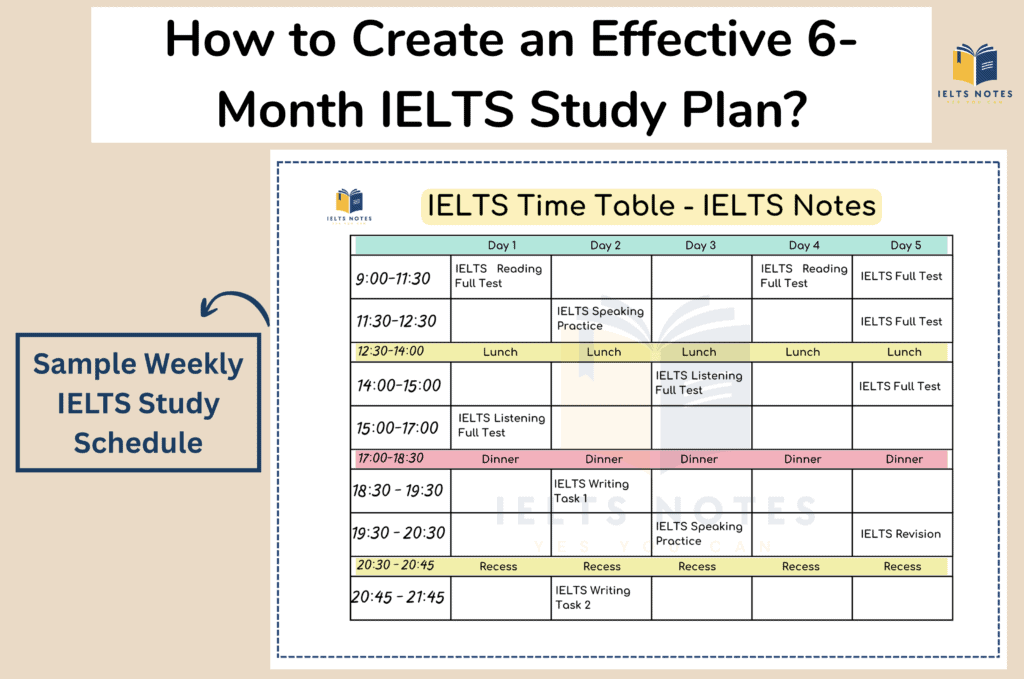
[Free Sample] 6-Month IELTS Study Plan
Here are all the tips and strategies you can use to build a structured and effective IELTS study plan. You can also check out IELTS Notes’ free sample study plan below:

You can refer to this sample timetable to plan your IELTS study schedule. Click the button below to download the COMPLETELY FREE IELTS study timetable from IELTS Notes.

Conclusion
This 6-month IELTS study plan is structured into clear stages – from checking your current level and building a strong foundation, to practicing question types, training each skill part-by-part, and finally doing full mock tests before your exam. The most important thing in IELTS preparation isn’t using as many resources as possible. It’s studying at the right stage, with the right goals, and always taking time to review and learn from your mistakes after every practice session.
If you found this study plan helpful in your IELTS journey, feel free to follow IELTS Notes on Facebook, Tiktok, Youtube, and Pinterest. We’ll keep sharing practical guidance and learning resources to support you as you work toward your target band.