

Culture is a topic that frequently appears in both the Speaking and Writing sections of the IELTS exam, especially in Speaking Part 2 and Writing Task 2. Students are very likely to be asked to talk or write about the customs, traditions, festivals, or lifestyle of a particular country or community.
To achieve a band score of 8 or above, it is important to use culture-related vocabulary naturally, combining it with appropriate collocations, idioms, and expressions, rather than merely listing basic terms.
In this article, you will learn over 50 important words and phrases related to culture, organized into common themes in IELTS. Each section includes illustrative examples so that you can apply them directly in your Speaking and Writing tasks, helping to enhance your score effectively.
IELTS Speaking Culture-Related Vocabulary
Culture and Traditions Vocabulary
- culture = the ideas, customs, and social behaviour of a society
- cultural heritage = the legacy of physical artifacts and intangible attributes inherited from past generations
- tradition = the transmission of customs or beliefs from generation to generation
- customs = established practices or habitual actions of a society
- values = the principles or standards of behaviour considered important in a society or by an individual
- rituals = prescribed or established ceremonies or actions
- beliefs = convictions or accepted truths held by a group or individual
- celebrate = to observe an event or occasion with enjoyable activities
- festival = a day or period of celebration, often with cultural or religious significance
- ceremony = a formal event or ritual performed on special occasions
- folklore = traditional stories, myths, or legends of a community
- indigenous practices = traditional practices originating among native peoples
- social norms = expected rules of behaviour within a society
- etiquette = conventional forms of polite behaviour in society
- lifestyle = the way in which a person or group lives
- contemporary culture = modern-day practices, ideas, and expressions of a society
- cultural identity = the sense of belonging to a particular culture
- cultural diversity = the existence of a variety of cultural or ethnic groups within a society
- ancestral customs = traditional practices passed down from previous generations
- traditional values = long-established beliefs or moral principles in a culture
- intangible heritage = non-physical aspects of culture, such as rituals, practices, and expressions
- community rituals = ceremonies or practices performed collectively within a community
- cultural celebrations = events or activities that commemorate cultural or traditional heritage
- moral principles = rules or standards governing ethical behaviour
Cultural Heritage & Preservation Vocabulary
- heritage site = historical site, place of heritage
- intangible heritage = non-physical cultural heritage
- preservation = the act of preserving or maintaining
- conservation = the protection of cultural or environmental assets
- protect heritage sites = to safeguard historical or cultural sites
- safeguard traditions = to maintain and protect traditions
- cultural preservation = the act of preserving cultural practices and heritage
- maintain cultural identity = to uphold a community’s cultural characteristics
- historical landmark = a site or structure of historical significance
- cultural relics = artifacts or objects of cultural importance
- traditional crafts = traditional handicrafts
- oral traditions = traditions transmitted orally from generation to generation
- folklore heritage = the body of traditional stories and beliefs
- restore monuments = to repair and restore historical buildings or monuments
- cultural tourism = tourism focused on cultural experiences and heritage
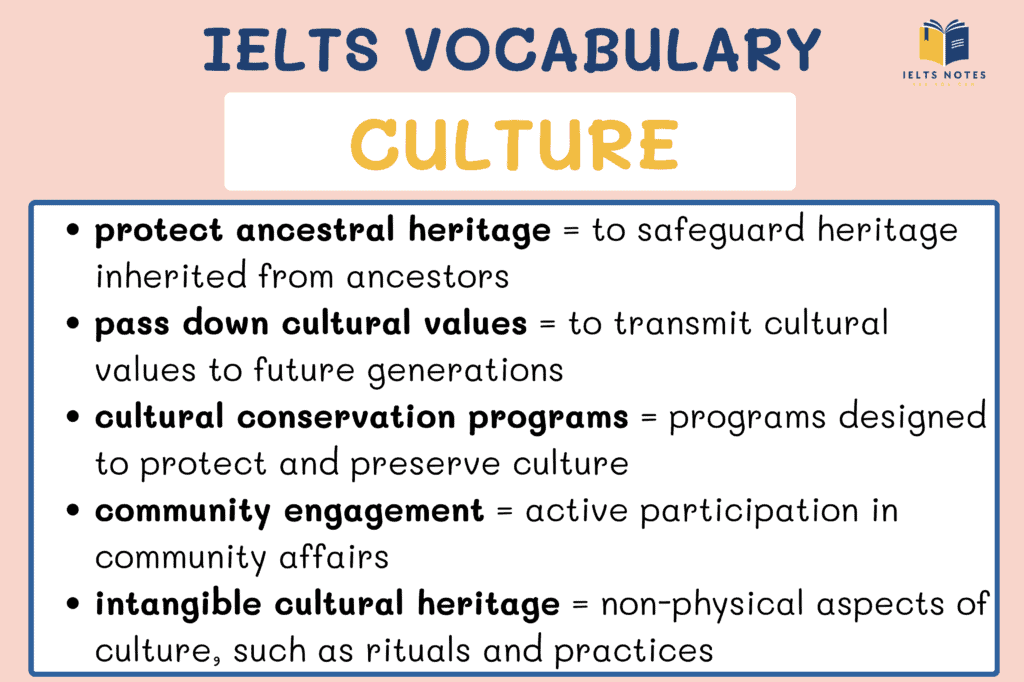
- protect ancestral heritage = to safeguard heritage inherited from ancestors
- intangible assets = non-physical cultural assets
- pass down cultural values = to transmit cultural values to future generations
- endangered cultural practices = cultural customs or practices at risk of disappearing
- maintain historical authenticity = to preserve the original historical characteristics
- cultural conservation programs = programs designed to protect and preserve culture
- heritage management = the administration and management of cultural heritage
Read more
Lifestyle & Cultural Practices Vocabulary
- social norms = expected rules of behaviour within a society
- etiquette = conventional forms of polite behaviour in society
- lifestyle = the way in which a person or group lives
- contemporary culture = modern-day practices, ideas, and expressions of a society
- way of life = a person’s or group’s typical manner of living
- customs and traditions = established practices and inherited cultural rituals
- pass down = to transmit from one generation to another
- cultural practices = habitual or traditional practices of a culture
- daily routine = habitual activities carried out daily
- work-life balance = the equilibrium between work responsibilities and personal life
- leisure activities = recreational or free-time activities
- modern lifestyle = contemporary ways of living
- traditional way of life = long-established, customary lifestyle
- community engagement = active participation in community affairs
- family-oriented lifestyle = a lifestyle centered around family values
- healthy habits = practices that promote physical and mental well-being
- social customs = socially accepted practices or behaviours
- spiritual practices = routines or rituals related to spiritual or religious beliefs
- contemporary values = modern societal principles or standards
- cultural identity = the sense of belonging to a particular culture
- peer influence = the effect of peers or social group on behaviour
- personal development = activities or practices aimed at improving oneself
- uphold traditions = to maintain and preserve longstanding cultural practices
Cultural Changes & Influence Vocabulary
- globalization = the process of becoming more connected and interdependent worldwide
- cultural exchange = the sharing of ideas, customs, and traditions between cultures
- adaptation = the process of adjusting to new cultural conditions
- modernization = the process of making something more modern in structure or practices
- influence by foreign culture = being affected or shaped by another culture
- adapt cultural norms = to adjust to the standards and customs of another culture
- embrace diversity = to welcome and accept cultural differences
- cross-cultural interaction = communication or collaboration between people of different cultures
- cultural assimilation = the process of adopting the cultural traits of another group
- social transformation = significant changes in societal structures or behaviours
- cultural diffusion = the spread of cultural elements from one society to another
- intercultural communication = exchanging information effectively between cultures
- hybrid culture = a culture formed by the combination of two or more distinct cultural influences
- cultural globalization = the worldwide spread and integration of cultural practices and ideas
- cultural convergence = the coming together of different cultures through shared practices or values
- cultural adaptation = modifying one’s behaviour or practices to fit a new cultural environment
- influence of mass media = the effect of media channels on cultural perceptions and behaviours
- modernization process = the series of changes that make society more contemporary
- global cultural trends = prevailing patterns or shifts in culture on a worldwide scale
- cultural integration = the process of combining different cultural groups into a cohesive society
- cultural identity preservation = maintaining the unique characteristics and traditions of a culture
- societal change = alterations in social structures, norms, or values
- cultural shift = a notable change in cultural attitudes, values, or practices
Read more
Culture-Related Collocations & Idioms
- deeply rooted traditions = traditions that are firmly established and embedded in society
- cultural melting pot = a place where multiple cultures coexist and blend together
- lose cultural identity = to lose the distinctive characteristics of a culture
- preserve cultural heritage = to maintain and protect cultural legacy
- pass down traditions = to transmit traditions from one generation to another
- cultural legacy = heritage and achievements of a culture
- embrace cultural diversity = to welcome and accept a variety of cultures
- cultural assimilation = the process of adopting the cultural traits of another group
- uphold customs = to maintain and respect traditional practices
- ancestral customs = customs inherited from ancestors
- cultural norms = accepted rules or standards of behaviour within a culture
- traditional values = long-established beliefs or moral principles
- cross-cultural understanding = awareness and comprehension of different cultures
- intercultural communication = effective communication between people of different cultures
- heritage site = a location of historical or cultural significance
- intangible cultural heritage = non-physical aspects of culture, such as rituals and practices
- celebrate cultural identity = to honor and value one’s cultural characteristics
- cultural exchange program = organized programs promoting interaction between cultures
- retain historical character = to preserve the original features and authenticity of historical sites
- blend of cultures = a mixture of different cultural influences
- cultural revival = the restoration or renewed interest in cultural traditions
- social customs = established social practices within a community
- uphold cultural values = to maintain and support the principles of a culture
- cultural transformation = significant changes in cultural practices or values
- adopt cultural practices = to take on new cultural habits or traditions
- multicultural society = a society composed of multiple cultural or ethnic groups
- lose touch with tradition = to become disconnected from traditional practices
Culture-Related Phrasal Verbs
- pass down = to transmit from one generation to another
- pick up = to learn or acquire (habits, language, practices)
- take part in = to participate in (cultural activities, festivals)
- live up to tradition = to maintain or follow traditions
- carry on = to continue practicing customs or rituals
- come across = to encounter or experience a different culture by chance
- hand down = to pass on heritage or values from previous generations
- blend in = to integrate naturally into a cultural environment
- stand out = to be noticeably different or distinctive in a cultural context
- bring about = to cause or lead to cultural change
- adapt to = to adjust to new cultural norms or lifestyles
- conform to = to comply with social norms or customs
- follow in = to continue a tradition or follow the cultural path of ancestors
- take after = to resemble someone in the family in lifestyle or habits
- come together = to gather or unite in cultural activities
- set up = to establish (a festival, cultural organization, or event)
- grow into = to develop or become a part of a culture
- die out = to gradually disappear (customs, practices)
- fill in = to fill gaps in cultural knowledge
- slow down = to reduce the pace of modernization or cultural change
- hand over = to transfer control or management of a heritage, festival, or cultural asset
- live on = to continue to exist (traditions, practices)
- spring up = to appear quickly (festivals, cultural trends)
- tear down = to demolish (old cultural buildings or monuments)
- spread out = to expand cultural influence over a wide area
IELTS Speaking Part 1: Topic – Culture
Do you think this festival will still be as important in the future?
Yes, I do. Festivals are an integral part of our culture and help preserve cultural heritage. They allow people to take part in traditions and pass down values to younger generations. Even with modernization, I believe such events will remain deeply rooted and continue to be valued in the future.
Do you think that there should be more holidays in your country?
Yes, I think having more holidays would help people embrace cultural diversity and give them time to take part in traditional activities. It could also strengthen the sense of community, which is really important for preserving our cultural identity.
What are some forms of traditional dancing in your country?
In Thailand, several traditional dances reflect our rich cultural heritage. For example, classical Thai dance often tells stories from history or mythology, while folk dances are performed during festivals to celebrate cultural identity.
Useful Vocabulary:
- integral part of a culture = a fundamental and essential element of a society’s culture
- preserve cultural heritage = to maintain and protect cultural legacy
- take part in traditional activities = to participate in cultural or traditional practices
- pass down values = to transmit moral or cultural principles to younger generations
- embrace cultural diversity = to welcome and accept a variety of cultures
- sense of community = the feeling of belonging and connection within a group or society
- cultural identity = the characteristics and sense of belonging that define a culture
- classical Thai dance = a traditional Thai performance art that tells stories through movement
- folk dances = traditional community dances that are part of local cultural celebrations
- celebrate cultural identity = to honor and recognize the unique traits of a culture
IELTS Speaking Part 2: Describe a foreign culture that you like
You should say
- What risk you took
- What bad thing you thought might happen
- Why you decided to take this risk
And explain why the result of taking this risk was positive.
Sample Answer:
One foreign culture that has always fascinated me is the Japanese philosophy of Wabi-sabi, which celebrates the beauty in imperfection and the passage of time. I first encountered it through Kintsugi, the art of repairing broken pottery with gold, and it immediately intrigued me because it reflects a very different way of appreciating everyday objects and life itself.
At first, I felt a bit hesitant to explore this philosophy more deeply. The risk I took was trying to learn about a cultural practice so unfamiliar to me, and I worried that I might misinterpret the traditions or fail to understand the deeper meanings behind the art and rituals. I also feared that, as someone outside the culture, I might unintentionally show a lack of respect.
Despite these concerns, I decided to take the risk because I wanted to embrace cultural diversity and gain a personal insight into a philosophy that values simplicity, mindfulness, and reflection. I felt that observing and studying Wabi-sabi could not only broaden my perspective but also influence how I perceive the world around me.
The outcome was extremely positive. By reading about Wabi-sabi, watching demonstrations of Kintsugi, and discussing the philosophy with knowledgeable friends, I was able to appreciate the cultural heritage and values underlying the practice. It gave me a fresh perspective on life, helping me see beauty in imperfection and impermanence, and it encouraged me to reflect on my own habits and approach to everyday objects.
Overall, exploring Wabi-sabi was a meaningful experience. It reinforced how traditions can convey profound lessons, how culture shapes personal understanding, and how stepping out of one’s comfort zone can lead to deep appreciation and growth.
Useful Vocabulary:
- misinterpret the traditions = to understand cultural practices incorrectly or inaccurately
- embrace cultural diversity = to welcome and accept a variety of cultures
- cultural heritage = the legacy of physical and intangible cultural assets inherited from previous generations
- a fresh perspective on life = a new way of understanding or viewing life and experiences
- step out of one’s comfort zone = to take actions that challenge personal limits or familiar routines
Read more
IELTS Speaking Part 3: Topic – Culture
What do you think is the best way to learn foreign culture?
I think there are several ways to learn a foreign culture, and each has its own advantages. The most effective method is to experience it firsthand by spending time in the country, observing local traditions, and interacting with people. This allows you to understand how cultural values shape daily life and social behaviours.
However, not everyone has the opportunity to travel. In that case, studying the culture through books, documentaries, or articles can still provide useful insights into its cultural heritage and core principles. Combining both approaches can give a more meaningful understanding without missing important details.
What do you think is the biggest problem of working in a foreign country?
I think there are several challenges when working in a foreign country. One of the biggest problems is not being familiar with the local culture and social norms, which can make daily interactions and teamwork more difficult. Language barriers and differences in lifestyle can also cause misunderstandings or feelings of isolation.
Another significant challenge is dealing with potential discrimination or bias, which can affect both professional opportunities and personal comfort. Overall, adapting to a new environment requires flexibility, open-mindedness, and a willingness to learn from the cultural heritage of the host country.
Some people say that reading is the best way to know about a culture. Do you agree?
Yes, I agree. Reading allows people to gain a thorough understanding of a culture’s customs, belief systems, and historical background. Through literature, articles, or travel guides, learners can explore the unique practices and rituals that define a society without physically being there.
At the same time, I believe combining reading with observation or interaction can enhance learning. Even attending local events or watching documentaries can give a clearer sense of daily life in that culture, making the knowledge more practical and memorable.
Useful Vocabulary:
- experience culture firsthand = to gain direct personal exposure to a culture by visiting or participating
- traditions = established cultural practices passed through generations
- cultural heritage = the legacy of physical and intangible cultural assets inherited from previous generations
- customs = habitual or traditional practices of a society
- belief systems = the set of principles or ideologies held by a group or society