

In this article, IELTS Notes will introduce useful IELTS Science vocabulary words and phrases, along with collocations, idioms, phrasal verbs, and sample answers to help you use them effectively in both IELTS Speaking and IELTS Writing.
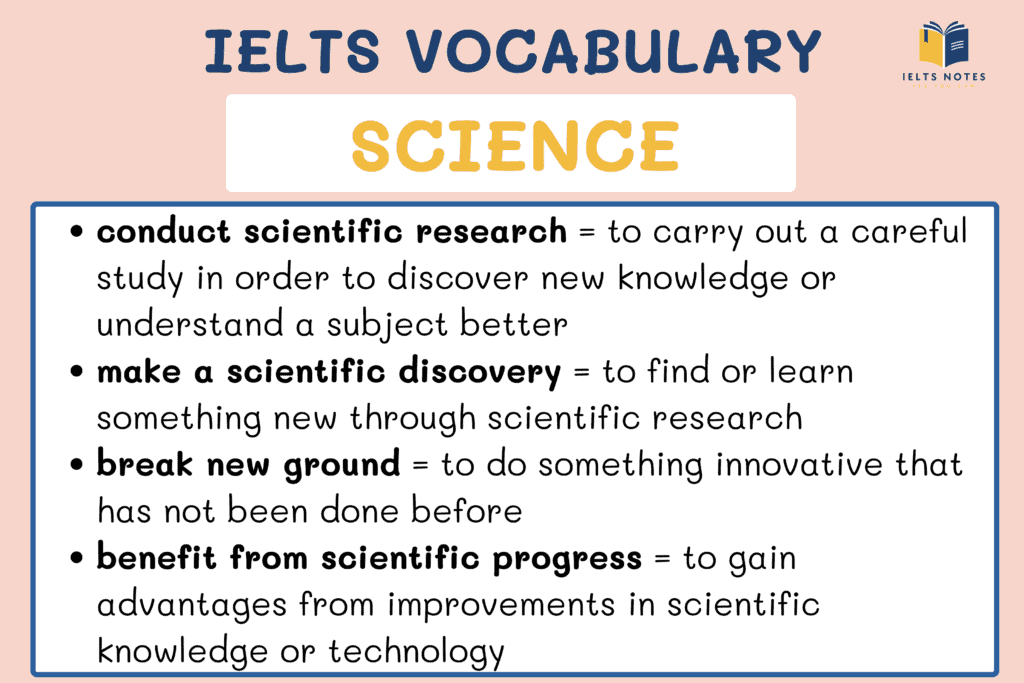
IELTS Science Vocabulary by Topics
General Science & Research Vocabulary
- scientific research = a careful and systematic study carried out to discover new knowledge or better understand a subject
- scientific evidence = information, data, or facts that support a scientific idea, claim, or conclusion
- scientific method = a structured process used by scientists to test ideas through observation, experiments, and analysis
- experiment = a scientific test carried out to discover what happens under specific conditions
- laboratory = a special place where scientific experiments, tests, or research are carried out
- hypothesis = an idea or explanation that can be tested through research or experiments
- theory = a well-developed explanation for something, based on evidence and repeated testing
- data = facts, numbers, or information collected for analysis or research
- research findings = the results or conclusions produced by a research study
- research outcome = the final result or effect of a research project or scientific study
- scientific discovery = something new that is found or learned through scientific research
- researcher = a person who studies a subject carefully in order to discover new information
- scientist = a person who studies science and carries out research or experiments
- academic research = research carried out in universities or educational institutions to increase knowledge
- field study = research carried out in a real-world setting rather than in a laboratory
- clinical trial = a scientific study that tests the safety and effectiveness of a medical treatment on people
- peer-reviewed study = a research study that has been checked and evaluated by other experts in the same field
- scientific knowledge = information and understanding gained through scientific study and research
- research-based approach = a way of making decisions or solving problems based on research and evidence
- evidence-based conclusion = a conclusion that is supported by reliable facts, data, or scientific evidence
- research methodology = the methods and procedures used to conduct a research study
- controlled experiment = an experiment in which certain conditions are kept the same to test the effect of one specific factor
- scientific observation = the careful act of watching, measuring, or recording something for scientific purposes
- research data = information collected and analysed as part of a scientific study
- empirical evidence = evidence based on observation, measurement, or real-world experience rather than opinion
- reliable results = results that are consistent, trustworthy, and likely to be accurate
- scientific analysis = the careful examination of data or evidence to understand a scientific issue
- research process = the series of steps involved in planning, conducting, and analysing a study
- scientific explanation = an explanation based on evidence, logic, and scientific understanding
- practical application = the real-life use of scientific knowledge, research, or technology
- scientific investigation = a detailed study carried out to answer a scientific question or solve a problem
Read more
Scientific Discoveries & Innovation Vocabulary
- scientific breakthrough = an important scientific discovery or achievement that helps solve a problem or create new possibilities
- technological innovation = the development or use of new technology to improve products, services, or ways of doing things
- major discovery = an important new finding that changes people’s understanding of a subject
- groundbreaking research = research that introduces new ideas, methods, or discoveries in a particular field
- cutting-edge technology = the most advanced and modern technology available at a particular time
- advanced technology = highly developed technology that is more modern, effective, or complex than older systems
- scientific advancement = progress or improvement in scientific knowledge, methods, or applications
- technological progress = the development and improvement of technology over time
- scientific progress = the growth of scientific knowledge and the development of better explanations, methods, or solutions
- modern invention = a newly created device, method, or system that is useful in modern life
- innovative solution = a new and creative way of solving a problem
- practical application = the real-life use of scientific knowledge, research, or technology
- life-changing discovery = a discovery that has a major positive impact on people’s lives
- revolutionary technology = technology that creates a major change in how people live, work, or solve problems
- transformative impact = a powerful effect that significantly changes a situation, industry, or society
- scientific contribution = something valuable that science or scientists add to knowledge, society, or human progress
- research development = the process of improving or expanding scientific ideas, methods, or discoveries
- new invention = a newly created product, device, or method that did not exist before
- technological device = a tool or machine created through technology to perform a particular function
- scientific invention = a new device, process, or method created through scientific knowledge and experimentation
- innovation-driven society = a society that develops and improves through new ideas, technology, and scientific progress
- research and development = the process of creating, testing, and improving new products, technologies, or scientific ideas
- emerging technology = new technology that is still developing but may become important in the future
- digital innovation = the use of digital technology to create new or improved systems, services, or solutions
- artificial intelligence = technology that allows machines or computer systems to perform tasks that normally require human intelligence
- automation = the use of machines or technology to do tasks with little or no human involvement
- robotics = the field of science and technology related to designing, building, and using robots
- space exploration = the scientific study and travel beyond Earth to learn more about space, planets, and the universe
- renewable energy technology = technology that produces energy from natural sources that can be replaced, such as sunlight, wind, or water
- scientific solution = a solution to a problem based on scientific knowledge, research, or evidence
- solve complex problems = to find answers to difficult issues that involve many factors
- drive innovation = to encourage or cause the development of new ideas, methods, or technologies
- shape the future = to strongly influence how society, technology, or human life will develop in the future
Medicine, Health & Biotechnology Vocabulary
- medical research = scientific research that aims to understand diseases, improve treatments, or develop new medical knowledge
- medical breakthrough = an important medical discovery or achievement that greatly improves healthcare or treatment
- biotechnology = the use of living organisms, cells, or biological processes to develop useful products or technologies
- genetic engineering = the process of changing the genes of an organism for scientific, medical, or agricultural purposes
- gene editing = a scientific technique used to make precise changes to DNA
- gene therapy = a medical approach that treats or prevents disease by changing or replacing faulty genes
- DNA sequencing = the process of identifying the exact order of genetic information in DNA
- genetic research = scientific study of genes, heredity, and how genetic factors influence living organisms
- genetic testing = medical testing used to identify changes in genes that may affect a person’s health
- stem cell research = scientific research involving special cells that can develop into different types of cells in the body
- regenerative medicine = a field of medicine focused on repairing or replacing damaged cells, tissues, or organs
- vaccine development = the scientific process of creating vaccines to protect people from diseases
- drug development = the process of researching, testing, and producing new medicines
- pharmaceutical research = scientific research focused on developing and improving medicines
- clinical trial = a scientific study that tests the safety and effectiveness of a medical treatment on people
- clinical treatment = medical care or treatment given to patients based on scientific and clinical knowledge
- life-saving treatment = medical treatment that can prevent death or greatly improve a patient’s chance of survival
- diagnostic tool = a test, device, or method used to identify a disease or medical condition
- early detection = the process of finding a disease or health problem at an early stage
- disease prevention = actions or methods used to reduce the chance of illness or disease
- preventive medicine = a branch of medicine focused on preventing diseases rather than only treating them
- public health = the health of people in a community or society as a whole
- healthcare system = the organisations, services, and professionals that provide medical care to people
- healthcare access = the ability of people to obtain medical services when they need them
- patient outcomes = the results of medical care, such as recovery, improved health, or quality of life
- life expectancy = the average number of years a person is expected to live
- infectious disease = a disease that can spread from one person, animal, or source to another
- chronic illness = a long-term health condition that usually requires ongoing care or management
- immune system = the body’s natural system for protecting itself against disease and infection
- immune response = the way the body reacts to and fights harmful substances, infections, or diseases
- personalised medicine = medical treatment designed for an individual based on their genes, health condition, or personal needs
- precision medicine = a medical approach that uses detailed information about a person’s genes, lifestyle, and environment to guide treatment
- biomedical research = scientific research that studies biology and medicine to improve human health
- epidemiology = the study of how diseases spread and affect different groups of people
- medical ethics = moral principles that guide decisions and behaviour in medicine and healthcare
- ethical concerns = worries about whether a scientific or medical practice is morally acceptable
- human trials = research studies in which medical treatments or products are tested on people under controlled conditions
- improve patient care = to make medical services, treatment, or support better for patients
- extend human life = to increase the length of time people are able to live through medical or scientific progress
Science, Society & the Environment Vocabulary
- environmental science = the scientific study of the environment and the way humans affect natural systems
- climate research = scientific research that studies climate patterns, climate change, and their effects on the planet
- climate change = long-term changes in global or regional climate patterns, often linked to human activities
- climate change mitigation = actions taken to reduce or limit the causes and effects of climate change
- global warming = the gradual increase in the Earth’s temperature, mainly caused by greenhouse gas emissions
- greenhouse gas emissions = gases released into the atmosphere that trap heat and contribute to climate change
- renewable energy = energy from natural sources that can be replaced, such as sunlight, wind, or water
- clean energy technology = technology that produces energy with little or no pollution
- sustainable development = development that meets current needs without harming the ability of future generations to meet theirs
- environmental protection = actions taken to prevent damage to nature, ecosystems, and natural resources
- natural resources = materials or features from nature, such as water, forests, minerals, land, and wildlife
- resource conservation = the careful use and protection of natural resources to prevent waste or depletion
- biodiversity = the variety of plants, animals, and other living organisms in a particular area or ecosystem
- ecosystem = a community of living things and their physical environment interacting as a system
- ecological balance = the stable relationship between living organisms and their natural environment
- environmental degradation = the worsening of the natural environment due to pollution, overuse, or human activity
- pollution control = actions or policies designed to reduce or manage pollution
- waste management = the process of collecting, treating, recycling, or disposing of waste properly
- scientific solution = a solution to a problem based on scientific knowledge, research, or evidence
- global challenges = major problems that affect many countries, such as climate change, pollution, poverty, or disease
- public awareness = the level of understanding that people have about an important issue
- scientific literacy = the ability to understand basic scientific ideas and use them to make informed decisions
- science education = the teaching and learning of scientific knowledge, methods, and thinking skills
- government funding = money provided by the government to support research, education, public services, or development
- scientific funding = financial support given to scientific research, projects, or institutions
- government investment in science = money spent by the government to support scientific research and innovation
- evidence-based policy = a policy or decision that is based on reliable data, research, and scientific evidence
- social impact = the effect that a development, policy, or scientific change has on people and society
- human progress = the improvement of human life, knowledge, health, and living standards over time
- quality of life = the overall standard of well-being, including health, comfort, safety, and life satisfaction
- long-term consequences = effects or results that continue for a long period of time
- ethical issue = a question or problem related to what is morally right or wrong
- ethical responsibility = the duty to act in a morally acceptable and socially responsible way
- technological dependence = a situation in which people or societies rely heavily on technology in daily life
- balance benefits and risks = to consider both the advantages and possible negative effects of something before making a decision
- address environmental problems = to take action to deal with issues such as pollution, climate change, or resource depletion
- solve global problems = to find effective ways to deal with major issues that affect the world
- protect future generations = to make decisions that help preserve health, resources, and living conditions for people in the future
Read more
Science-related Collocations
- conduct scientific research = to carry out a careful study in order to discover new knowledge or understand a subject better
- carry out experiments = to perform scientific tests to find out what happens under certain conditions
- collect reliable data = to gather information that is accurate, trustworthy, and useful for research
- analyse research findings = to examine the results of a study carefully in order to understand their meaning
- publish research findings = to make the results of a study available to the public or academic community
- support scientific research = to provide money, resources, or encouragement for scientific studies
- fund medical research = to provide financial support for studies related to health, diseases, or treatments
- invest in research and development = to spend money on creating, testing, and improving new ideas, products, or technologies
- advance scientific knowledge = to increase what people know and understand through science
- make a scientific discovery = to find or learn something new through scientific research
- achieve a scientific breakthrough = to make an important scientific discovery or major step forward
- provide scientific evidence = to give facts, data, or research results that support a scientific claim
- base decisions on evidence = to make choices using reliable facts, data, or scientific research rather than personal opinions
- challenge existing theories = to question or test ideas that are already accepted in science
- develop new technology = to create or improve technology for practical use
- adopt advanced technology = to start using modern and highly developed technology
- drive technological innovation = to encourage or cause the development of new technologies and methods
- benefit from scientific progress = to gain advantages from improvements in scientific knowledge or technology
- transform people’s lives = to change the way people live in a significant way
- improve quality of life = to make people’s health, comfort, safety, or daily living conditions better
- solve practical problems = to find useful answers to real-life issues
- address global challenges = to deal with major problems that affect many countries, such as climate change, disease, or energy shortages
- raise ethical concerns = to create worries about whether something is morally right or acceptable
- pose potential risks = to create possible dangers or negative consequences
- balance benefits and risks = to consider both the positive effects and possible dangers of something
- lead to medical breakthroughs = to result in important medical discoveries or improvements in treatment
- develop life-saving treatments = to create medical treatments that can prevent death or greatly improve survival
- improve patient outcomes = to make the results of medical care better for patients
- extend life expectancy = to increase the average number of years that people are expected to live
- reduce the spread of disease = to make it less likely for diseases to move from one person or place to another
- promote public health = to support and improve the health of people in a community or society
- protect the environment = to prevent damage to nature, ecosystems, and natural resources
- reduce carbon emissions = to lower the amount of greenhouse gases released into the atmosphere
- develop clean energy technology = to create technology that produces energy with little or no pollution
- promote sustainable development = to support development that meets current needs without harming future generations
- shape the future of society = to strongly influence how society will develop in the future
Idioms & Natural Expressions about Science and Innovation
- break new ground = to do something innovative that has not been done before
- push the boundaries = to go beyond existing limits in knowledge, technology, or human ability
- a double-edged sword = something that has both advantages and disadvantages
- ahead of its time = too advanced or modern to be fully understood or accepted when first introduced
- stand the test of time = to remain useful, respected, or effective for a long period
- trial and error = the process of learning or solving problems by trying different methods and learning from mistakes
- the tip of the iceberg = a small visible part of a much larger issue, problem, or discovery
- open the door to something = to create new opportunities or possibilities
- pave the way for something = to make future development or progress possible
- a turning point = an important moment that causes a major change in a situation or development
- a game changer = something that completely changes the way people do, understand, or approach something
- think outside the box = to think creatively and find new or unusual solutions
- at the cutting edge = at the most advanced stage of development in a field
- at the forefront of innovation = in a leading position in developing new ideas, technologies, or methods
- make a world of difference = to have a very significant positive effect
- raise more questions than answers = to create uncertainty or new issues that still need to be explored
- bring something to light = to reveal or discover information that was previously unknown
- fuel scientific progress = to encourage or support the development of scientific knowledge and discovery
- shape the future = to strongly influence how society, technology, or human life will develop
- change the way we live = to significantly affect people’s daily lives, habits, or behaviour
- drive innovation = to encourage or cause the development of new ideas, products, or technologies
- spark debate = to cause people to discuss or disagree about an issue
- raise ethical concerns = to create worries about whether something is morally acceptable
- pose new challenges = to create new difficulties or problems that need to be solved
- offer a promising solution = to provide a possible answer or method that seems likely to succeed
- hold great potential = to have a strong possibility of becoming useful, successful, or important
- a leap forward = a major improvement or advance in science, technology, or knowledge
- a step in the right direction = an action or development that helps make progress toward a better outcome
- on the horizon = likely to happen or become important in the near future
- revolutionise an industry = to completely change how an industry works
- transform everyday life = to greatly change people’s daily routines, habits, or living conditions
- bridge the gap = to reduce the difference between two groups, ideas, or levels of development
- go hand in hand with = to be closely connected with something and often happen together
- the benefits outweigh the drawbacks = the advantages are greater or more important than the disadvantages
- not without risks = having some possible dangers or negative consequences
- a matter of time = something that is very likely to happen eventually
- the next big thing = a new idea, product, or technology that is expected to become very successful
- from theory to practice = the process of applying an idea or scientific concept in real life
- make science more accessible = to help ordinary people understand or use scientific knowledge more easily
Read more
IELTS Speaking Part 1: Topic – Science
Do you enjoy science lessons at school?
To some extent, yes, but I wouldn’t say science was my favourite subject at school. I was more interested in social science than natural science, because subjects like chemistry or physics felt a bit dry to me.
What is the science subject you are most interested in?
Honestly, I’m not really into science, but if I had to pick one, I’d probably pick biology because it was easier for me to understand than subjects like chemistry or physics. I found it more connected to real life, especially when we learned about the human body, health, and basic scientific knowledge.
Do you watch science programmes on TV?
Not really. I don’t find science programmes very interesting, so I hardly ever watch them now. When I was younger, I sometimes watched programmes about environmental science and wildlife, especially shows about animals and biodiversity.
Useful Vocabulary:
- scientific knowledge = information and understanding gained through scientific study and research
- environmental science = the scientific study of the environment and the way humans affect natural systems
- biodiversity = the variety of plants, animals, and other living organisms in a particular area or ecosystem
IELTS Speaking Part 2: Describe an area of science that interests you
Describe an area of science that interests you (physics, biology, psychology, etc). You should say:
- What it is
- When you knew it
- How you learned it
And explain why you are interested in it
Sample Answer:
I’d like to talk about robotics, which is probably the only area of science that has really interested me so far. To be honest, I’ve never been a big fan of science in general, but robotics felt different because it was much more practical and interactive.
I first learned about it when I was in primary school. At that time, my school gave us a chance to join a basic robotics class. Since we were still very young, we only learned simple things, not anything too advanced. However, for a child at that age, it was still a fascinating experience.
In that class, I learned some basic ideas about robotics, electric circuits and simple programming. We were taught how a circuit worked, how different parts were connected, and how to give basic instructions so that a small robot could move or perform simple actions. I think that was my first time seeing a clear practical application of science, rather than just reading theories from a textbook.
What made it interesting to me was the fact that I could actually create something and see it work. Before that, I used to think science was dry and difficult, but robotics showed me that science could be creative and useful. It also helped me understand how advanced technology is built from very basic principles.
Of course, I was nowhere near the level of engineers or professional researchers, but that experience gave me a small insight into how machines can be designed and controlled. I think robotics is a field that can drive innovation and transform people’s lives, especially in areas like manufacturing, healthcare and education.
Overall, even though I’m not deeply interested in science now, robotics still stands out to me because it was the first area of science that made me feel curious. It helped me step out of my comfort zone, learn through trial and error, and realise that science can be much more exciting when it is connected to real life.
Useful Vocabulary:
- robotics = the field of science and technology related to designing, building, and using robots
- practical application = the real-life use of scientific knowledge, research, or technology
- advanced technology = highly developed technology that is more modern, effective, or complex than older systems
- drive innovation = to encourage or cause the development of new ideas, methods, or technologies
- transform people’s lives = to change the way people live in a significant way
- step out of someone’s comfort zone = to try something new or unfamiliar that may feel challenging at first
- trial and error = the process of learning or solving problems by trying different methods and learning from mistakes
Read more
IELTS Speaking Part 3: Topic – Science
Why do you think some people claim scientists interfere too much with nature?
I think some people say this because scientists often conduct research on animals, plants, genes, or natural systems, which can make people feel that humans are interfering too much with nature. Their concern is understandable, especially when some experiments are done carelessly or may raise ethical concerns.
However, I don’t think scientific research is necessarily harmful. In order to understand the Earth, living organisms, and environmental problems better, we still need science to help us solve practical problems. In my opinion, the key is to balance benefits and risks rather than completely stop scientific research.
Do you have anything against animal testing?
Yes, I do have strong concerns about animal testing. Personally, I find it quite inhumane, especially because animals cannot choose whether they want to be part of scientific experiments. I have seen many campaigns against animal testing, and they made me feel that scientists have an ethical responsibility to reduce harm as much as possible.
That said, I have to admit that I don’t work in medical research, so I don’t fully know what the best alternative would be. In some cases, scientists may need to test treatments carefully before they are used on humans, because new medicines can pose potential risks. Hopefully, in the future, science will develop life-saving treatments without having to test directly on innocent animals.
Useful Vocabulary:
- conduct scientific research = to carry out a careful study in order to discover new knowledge or understand a subject better
- raise ethical concerns = to create worries about whether something is morally right or acceptable
- solve practical problems = to find useful answers to real-life issues
- balance benefits and risks = to consider both the positive effects and possible dangers of something
- ethical responsibility = the duty to act in a morally acceptable and socially responsible way
- medical research = scientific research that aims to understand diseases, improve treatments, or develop new medical knowledge
- pose potential risks = to create possible dangers or negative consequences
- develop life-saving treatments = to create medical treatments that can prevent death or greatly improve survival